Blog

End-user engagement in Cluster 3 security proposals: how to plan it from the start

September 22, 2026

Subscribe to our blog

Receive the latest insights on European funding for research and innovation.

In Horizon Europe Cluster 3, involving end users is rarely optional. In the 2026 Civil Security for Society calls, 20 of the 24 topics require specific types of end-user or practitioner organisations to take part as beneficiaries. Where this applies, it is a formal eligibility condition: a proposal that does not meet it is rejected before its content is assessed.

Eligibility, however, is only the starting point. How end users are embedded in the work plan determines whether the project runs smoothly and whether the results are actually used once the funding ends. This blog looks at who counts as an end user in Cluster 3, and how to plan their involvement while you are still writing the proposal.

Which organisations count as end users?

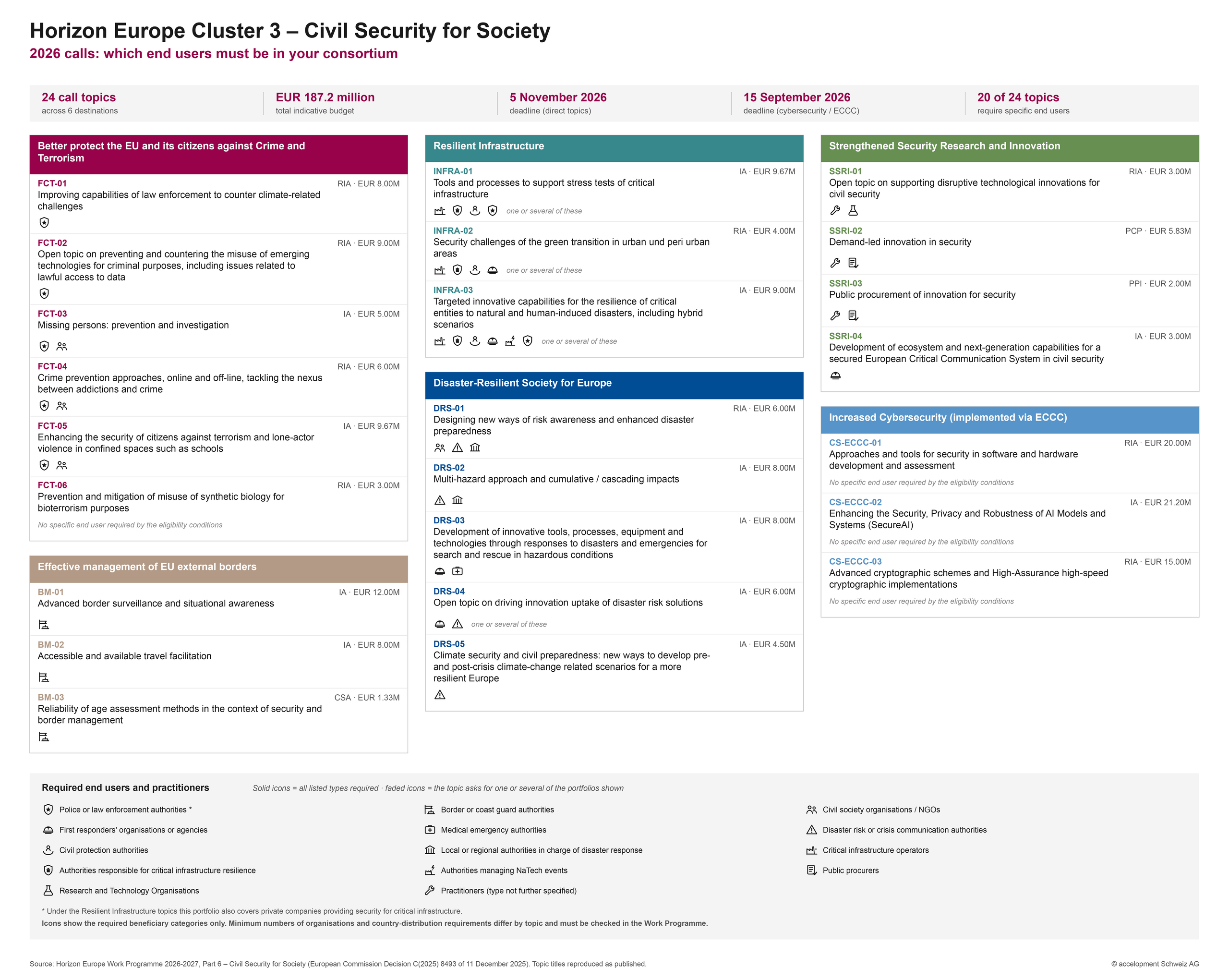
The Work Programme names end users by their function rather than by acronym. The table below explains the types referred to in the 2026 calls, using the same icons as the infographic above.

End-user typeWhat it covers
Police Authorities (LEA)National police forces and other bodies legally mandated to prevent, detect or investigate crime. Each topic defines the term in a footnote, so check that your partner qualifies.
Authorities in charge of disaster risk or crisis communicationPublic bodies with legally defined responsibilities for disaster risk management or crisis communication. The Resilient Infrastructure topics name civil protection authorities as a separate portfolio.
Civil Society Organisations / Non-Governmental Organisations (CSO / NGO)Organisations representing citizens, victims or groups in a vulnerable situation. Frequently required alongside police authorities in crime prevention topics.
First responders and practitioner organisationsFire and rescue services, search and rescue teams and comparable operational response units.
Border or Coast Guard Authorities (BCG)National border police and coast guards.  
Critical infrastructure operators and resilience authorities (CI)Operators of energy, transport, water, health or digital infrastructure. The Work Programme lists the authorities responsible for critical infrastructure resilience as a separate portfolio alongside the operators themselves.
Authorities managing NaTech eventsBodies responsible for natural hazards that trigger technological accidents, for example flooding or earthquakes affecting industrial sites. Required as a portfolio option under INFRA-03.
Practitioners (type not further specified)Any operational organisation relevant to the topic. The choice is left to the applicant, which allows more flexibility in consortium design.
Organisations representing local or regional authoritiesMunicipalities, regions and their representative networks, typically required for disaster preparedness at local level.
Public procurersPublic bodies with the mandate and budget to purchase solutions. Mandatory in the pre-commercial procurement (PCP) and public procurement of innovation (PPI) topics.
Medical emergency authoritiesEmergency medical services and public health bodies involved in crisis response.
Research and Technology Organisations (RTO)Applied research institutes that bridge research results and operational use.

It is worth going one level deeper than these categories. A single group of “end users” is usually too broad: frontline practitioners, laboratory analysts, technical managers, judicial users, procurers, policymakers and professional networks all have different needs. Distinguishing them in the proposal allows you to tailor both the engagement format and the message to each group.

Where end-user involvement is required in 2026 security call topics?

  • 20 of the 24 topics include an end-user or practitioner eligibility condition. The exceptions are the three cybersecurity topics implemented by the ECCC and the topic on synthetic biology (HORIZON-CL3-2026-01-FCT-06).
  • Requirements range from two named practitioner beneficiaries to combined role requirements, such as three practitioners and three public procurers. In the procurement topics one organisation may fulfil both roles, so the number of separate organisations can be lower than the sum suggests.
  • In most cases they must come from at least 2 or 3 different EU Member States or Associated Countries.
  • Four of the 2026 topics go a step further and ask for a mid-term deliverable in which the practitioners involved assess the project’s interim results (FCT-03, FCT-05, BM-01 and BM-02).

The infographic below shows all 2026 call topics per destination, with the end-user types required under each one.

2026 Cluster 3 call topics and the end users required under each topic

The call topics, budgets, deadlines and general proposal tips for 2026 are covered in our blog on Horizon Europe’s Cluster 3 Security Work Programme 2026.

How to include end users in your proposal?

Based on our experience, there are three stages where end-user involvement has to be planned: eligibility, the work plan, and the outreach (communication, dissemination and exploitation) measures.

Stage 1: Getting the eligibility conditions right

  • Read the condition literally. The wording is precise about numbers, types and countries. “At least 3 Police Authorities from at least 3 different EU Member States or Associated Countries” is not satisfied by three authorities from two countries, nor by a ministry that is not designated as a police authority under national law.
  • Secure commitments early. Public authorities usually need internal approval before joining a consortium, which can take weeks. Approaching them late is one of the most common reasons why otherwise strong consortia fail on eligibility.
  • Complete the practitioner table correctly. The “Information about security practitioners” or “Eligibility information about practitioners” table is a separate document in the submission system, not a section of Part B. Fill it in for every organisation that counts towards the condition, and make sure the roles stated there match the work plan.

Stage 2: Giving end users a real role in the work plan

  • Put genuine end users in the consortium. Include organisations that will actually operate, implement or procure the result, and give them scientific or technical tasks, person-months, budget and leadership responsibilities. Avoid confining them to an advisory board. A strong formulation is not “end users will be consulted”, but: End-user partners will define requirements, provide representative cases or data, lead operational validation and assess compatibility with existing workflows.
  • Start from requirements, not from finished prototypes. Use surveys, interviews, focus groups, casework analysis or workflow mapping at the beginning of the project, and convert the findings into user requirements, design specifications, validation criteria, KPIs and go/no-go decisions. This shows evaluators exactly how consultation will influence the research.
  • Document the feedback loop. Every engagement activity should have an identified destination in the work plan, for example: feedback from the practitioner workshop informs the prototype revision in a named task and the standardisation guidelines in a named deliverable. Plan several rounds across the innovation cycle – needs identification, prototype review, usability testing, operational validation, training and assessment of adoption barriers. One consultation at the start and a demonstration at the end is rarely sufficient, and four of the 2026 topics explicitly require a mid-term practitioner assessment.
  • Test in representative environments. Specify who will test the result, where, with which samples or scenarios, and against which criteria. Include practical measures alongside technical ones: usability, time required, cost, compatibility, training burden, robustness, legal acceptability and interoperability.
  • Budget realistically for their participation. Practitioner organisations often have limited capacity and cannot absorb costs themselves, and their workload has to remain compatible with their operational duties. Under lump-sum grants the overall EU contribution is fixed, so the effort allocated to end users has to be planned in detail from the start. Changes to activities or to the allocation of lump-sum shares remain possible, but may require a formal amendment and must be justified by project implementation.

Stage 3: Embedding end-user engagement in communication, dissemination and exploitation

  • Define end-user groups and their purpose. Distinguish between consortium practitioners, external users, professional networks, procurers and policymakers. For each group, specify which results are relevant, how they will be engaged and how their input will influence the project.
  • Make communication and dissemination two-way. Use workshops, demonstrations, training sessions and consultations not only to share results, but also to collect structured feedback on usability, validation, operational requirements and implementation barriers.
  • Use practitioner networks as active multipliers. European and national networks can recruit external testers, review guidance, distribute training materials and connect the project with organisations beyond the consortium. Assign them concrete responsibilities within the communication, dissemination and exploitation plan.
  • Connect with the wider security ecosystem to support uptake. Plan targeted exchanges with CERIS, relevant EU-funded projects, practitioner communities and, during implementation, appropriate EU agencies. These connections can help validate results, avoid duplication, test interoperability and identify procurement, deployment or follow-on funding pathways. Any planned agency engagement should respect the conditions of the relevant call topic.

Which organisations to approach, and how they work together, is the subject of the first blog in this series: Horizon Europe Cluster 3 proposals and projects: from security research to real-world impact.

How can we help you with your security proposal preparation?

At accelopment, we have extensive experience in securing EU funding for research and innovation projects, such as the successful CapCell Security proposal, which scored 15 out of 15 in the 2024 Horizon Europe Cluster 3 calls. With a strong track record in Horizon Europe projects, our team of experts supports researchers, companies and institutions throughout the entire funding process – from strategic grant planning, to proposal writing, project management and communication and dissemination. Based on our deep knowledge of Horizon Europe funding opportunities, we help our partners maximise their chances of success in securing European research grants and are involved in several successfully funded projects.

Are you preparing a Cluster 3 proposal and want to make sure your end-user involvement is both compliant and convincing? Reach out to our CapCell team to discuss how we can support you with our services.

Jacqueline Strehler

Research & Innovation Project Manager

Alexandra Furio

Project Manager Communications & Development
©accelopment Schweiz AG
+41 44 455 66 00 
info@accelopment.com  
ISO 9001 certified
© 2026 accelopment. All rights reserved.