Andreia Cruz
Research & Innovation Project Manager

The European Innovation Council (EIC) has announced the selection of 43 projects under the EIC Pathfinder Open 2026 call, each eligible to receive up to €4 million in funding. From innovative cancer treatments to quantum computing and climate-resilient agriculture, the selected projects demonstrate Europe’s ambition to turn high-risk scientific discoveries into transformative technologies. With record proposal numbers for the second consecutive year, the results also highlight the intense competition for bottom-up research funding. What do these results tell us about the EIC’s priorities and what can future applicants learn from the selected projects?
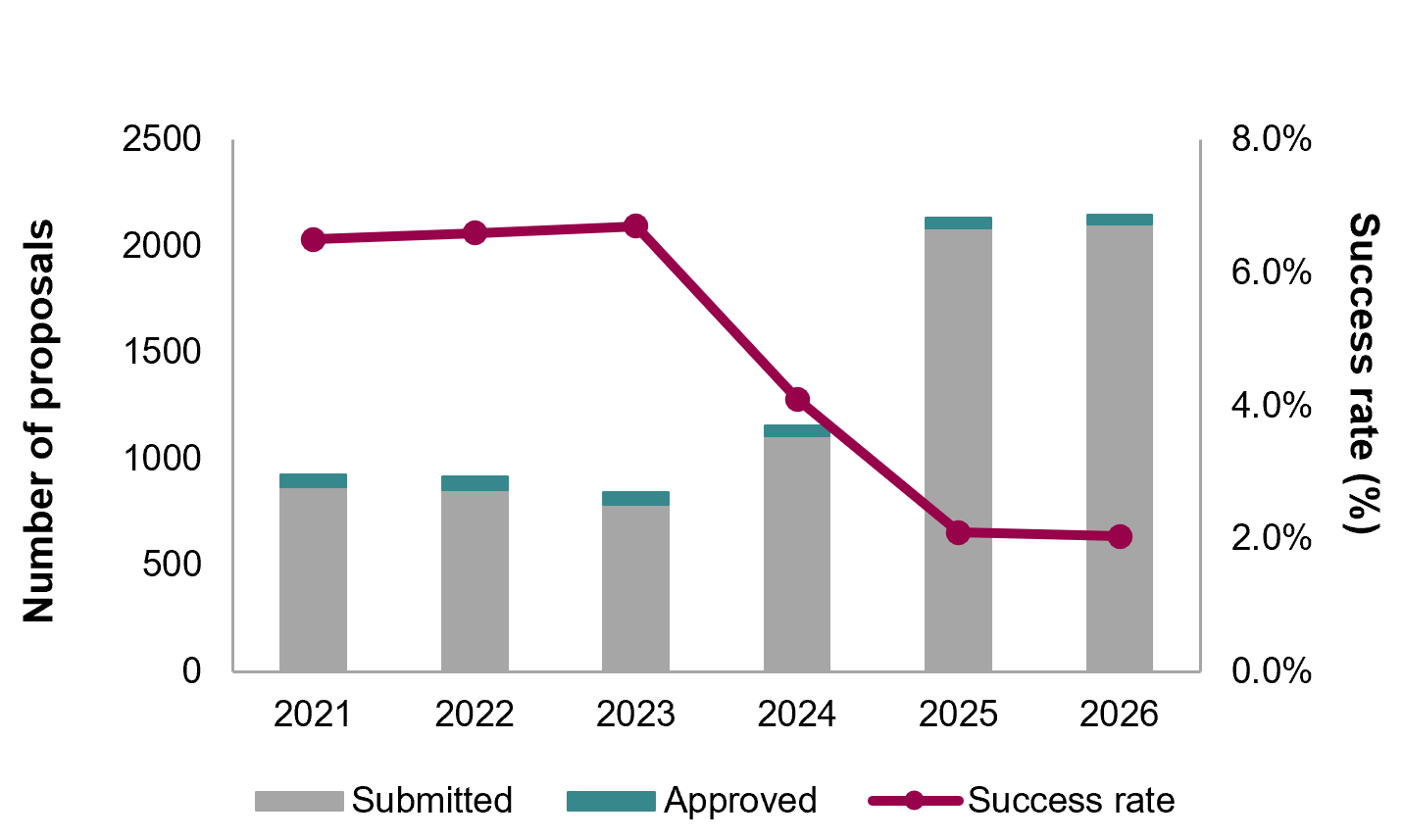
The EIC Pathfinder instrument supports early-stage research into radically new technologies with the potential to create new markets or address major societal challenges. Unlike funding schemes focused on specific innovations, Pathfinder encourages ambitious scientific approaches that challenge existing technological limitations and develop breakthrough technologies. In 2026, the EIC reports record proposal numbers for the second consecutive year, with 2,103 proposals submitted under the EIC Pathfinder Open 2026 call in May earlier this year. Of these, only 43 projects were selected for funding, corresponding to a selection rate of approximately 2.0%. Notably, the success rate has only slightly decreased from last year as shown here:
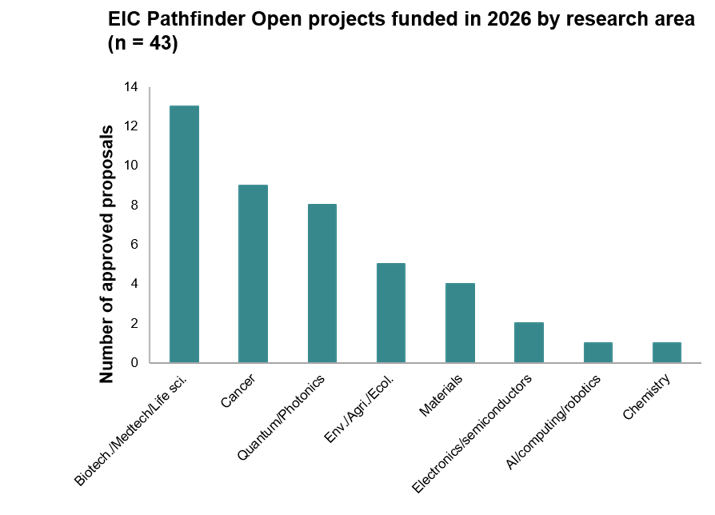
A closer look at the 43 projects selected under EIC Pathfinder Open 2026 reveals a strong emphasis on health-related innovations and emerging technologies. Biotechnology, medical technology and life sciences represent the largest research area, with 13 projects, followed by cancer research (9 projects) and quantum technologies and photonics (8 projects). Together, these three categories account for approximately 70% of the selected portfolio. Environmental, agricultural and ecological innovations (5 projects) and advanced materials (4 projects) also feature prominently, while electronics and semiconductors (2 projects), AI, computing and robotics (1 project), and chemistry (1 project) complete the portfolio. Although EIC Pathfinder Open follows a bottom-up approach without predefined thematic priorities, this distribution offers valuable insights into the research areas represented among successful applicants in 2026. It also highlights the programme’s commitment to supporting breakthrough innovations across diverse scientific disciplines.
Additionally, the funded consortia reflect the collaborative nature of Pathfinder research and bring together a mix of organisations. Higher and secondary education institutions account for the largest share of consortium participations (44%), followed by research organisations (28%) and private companies (25%). Other organisations, including public bodies, represent the remaining 3%. Notably, SMEs are involved in 34 of the 43 selected projects, underlining their role in bridging early-stage scientific research and future technological applications. distribution reflects the programme’s strong academic foundation while highlighting the importance of cross-sector collaboration. For future applicants, these results demonstrate the value of building interdisciplinary consortia that combine scientific excellence.
The draft EIC Work Programme 2027 introduces significant changes to the EIC Pathfinder Open application process. The most important change is the introduction of a two-stage submission and evaluation procedure, replacing the previous single-stage approach. Applicants will first submit a short proposal focusing on scientific excellence and potential impact. Only shortlisted consortia will be invited to develop a full proposal, followed by an interview for proposals meeting the second-stage evaluation thresholds. This new process will require applicants to communicate their technological vision and scientific breakthrough convincingly from the outset.
The draft Work Programme allocates €166 million to the 2027 EIC Pathfinder Open call, with grants of up to €4 million considered appropriate like before, although larger amounts may be requested with adequate justification. Applicants should monitor the publication of the final Work Programme (expected in in the beginning of November 2026) before finalising their submission strategy. The specific details will be explained in another blog post once the official Work Programme is published. that regulators can actually use.
With years of hands-on experience in preparing successful proposals, we have become a trusted partner for ambitious researchers applying to the EIC Pathfinder Open. Having already supported the preparation of successful Pathfinder projects in Horizon Europe – PEARL-DNA, POLINA, PIONEAR, BoneOscopy and the recently completed CORENET, our team at accelopment is well-equipped to craft a proposal that captures the evaluators’ attention. Our track record extends back to the FET programme in H2020, the predecessor of the EIC Pathfinder, where we contributed to pioneering projects such as CLASSY, FRINGE and Lumiblast.
If you are considering a resubmission or developing a new proposal, we offer tailored support, including proposal reviews, strategic input on impact and hands-on guidance throughout every step of the process. As in many of our successful collaborations, we can also be a project partner providing support in the efficient management of the project and the communication and exploitation of project results.
Our team is ready to help you transform your innovative ideas into a strong and compelling project proposal. Don’t hesitate to get in touch and discover how our experience can strengthen your Pathfinder application.