Andreia Cruz
Research & Innovation Project Manager
The European Commission (EC) has adopted the EIC Work Programme 2027, which allocates over €1.8 billion to breakthrough research, deep-tech innovation and business growth. As the final European Innovation Council (EIC) Work Programme under Horizon Europe 2021–2027, it introduces significant changes to several funding instruments. New evaluation procedures, stricter eligibility requirements and revised submission deadlines will affect how researchers, start-ups and companies prepare their applications. Beyond these procedural changes, the programme reinforces Europe’s ambition to develop and scale strategically important technologies. In this blog post, we examine the main changes that applicants should understand before preparing their 2027 proposals.
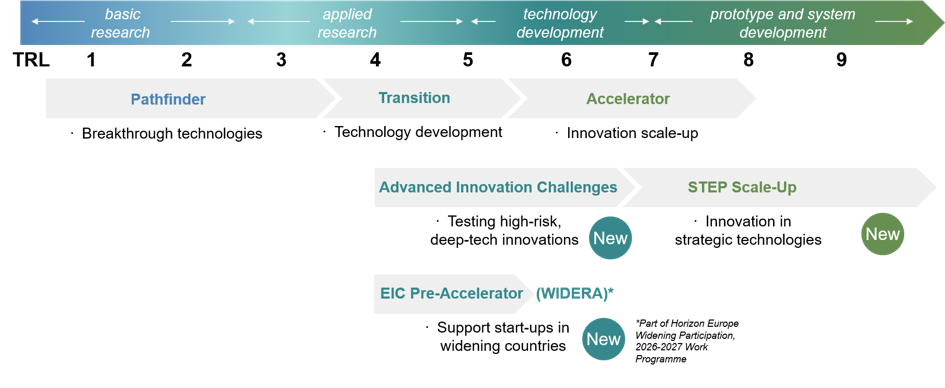
One of the most significant changes in the EIC Work Programme 2027 concerns the EIC Pathfinder Open, which replaces its previous single-stage procedure with a two-stage submission and evaluation process.
With an indicative budget of €166 million, Pathfinder Open continues to fund high-risk, high-gain research aimed at developing radically new technologies. However, applicants must now prepare for two evaluation steps:
Alongside Pathfinder Open, the EIC allocates €82 million to three EIC Pathfinder Challenges addressing strategic European priorities:
The deadline for all three Challenges is 29 September 2027. Unlike Pathfinder Open, these calls use portfolio-based selection to establish complementary groups of projects addressing specific objectives. Applicants should therefore carefully examine the relevant Challenge’s expected outcomes and explain how their research contributes to the broader portfolio ambitions.
The EIC Transition instrument undergoes a fundamental change in 2027. With a deadline on the 14 September 2027, the key change is that the applications must be „mono-beneficiary“, i.e. one organisation can apply but not a consortium with several partners as before. Affiliated entities and subcontractors remain possible where justified. With an indicative budget of €92 million for 2027, the EIC Transition supports the development of research results towards application-relevant environments and increased business readiness.
The revised application introduces several important requirements:
Like before, Transition applications must build on results generated by other EIC, Cluster or other projects. The EC will most likely provide an updated list of eligible originating projects, which will be published on the EIC Transition website at a later stage. Applicants must carefully verify the eligibility of their underlying research results and provide appropriate evidence of ownership or access rights.
The EIC Work Programme 2027 also introduces changes to instruments supporting later-stage innovation and company growth.
The EIC Work Programme 2027 offers substantial opportunities, but applicants must adapt to new evaluation procedures and stronger expectations concerning technological ambition and innovation readiness.
Early preparation is particularly important for Pathfinder Open and Transition applicants navigating redesigned application processes. The EC’s online information days on 19 and 20 November 2026 provide an opportunity to learn more about the new requirements directly from EIC representatives.
If you are unsure whether Pathfinder, Transition, Advanced Innovation Challenges, Accelerator or STEP Scale-Up best fits your innovation, our team can support you with readiness assessment, positioning and proposal strategy. accelopment supports innovators across the full EIC pathway, from early breakthrough research to large-scale commercialisation. We at accelopment have successfully supported many EIC Pathfinder projects, including three recently approved Pathfinder Open (BoneOscopy, CORENET, POLINA and PIONEAR) and one Pathfinder Challenge (PEARL-DNA) projects. If you have an innovative idea and are interested in our support for proposal writing, feel free to contact us.
From FET-Open to EIC Pathfinder, our taste for project ideas that address global challenges stays the same. Have a look at our proposal writing services and contact our EIC Pathfinder experts to discuss how we can best support you with your ambitions.
Nothing suitable in the EIC Work Programme?
Not every strong innovation idea will be a perfect match for the EIC instruments, especially given their high selectivity and specific expectations. This does not mean that funding options are exhausted. On the contrary, there are many alternative opportunities across Horizon Europe that may be better suited to your innovation’s maturity and objectives. Through our strategic grant planning, we help research teams navigate the funding landscape and decide where to focus their efforts. Through this service, we help position your project where it has the strongest chance of success and design a funding pathway that supports long-term development rather than a single call.