
Horizon Europe Impact section changes in 2026 – how applicants should adapt
10th February 2026 at 6:17 pm
The European Commission has revised the Standard Application Forms for Horizon Europe proposals under the 2026–2027 Work Programmes, with changes taking effect from January 2026. While the overall evaluation criteria remain unchanged, the Impact section has been significantly streamlined. Requirements have been simplified, page limits reduced and long-standing elements such as the mandatory description of scale and significance of impacts have been removed.
These changes are not simply cosmetics. They reflect a deliberate shift in how evaluators are expected to read and assess Impact. Applicants who continue to structure their proposals according to pre-2026 logic risk wasting space on elements that no longer add value or missing what now matters most. This blog explains how the Impact section was structured before, what has changed in the 2026 template and how applicants should adapt their writing strategy in practice to meet evaluator expectations under the revised framework. A broader overview of the 2026–2027 template changes, including page limits and implementation-related updates, is discussed in our latest related blog.
How the Impact section has changed – before and after January 2026
Before January 2026, the Impact section of Horizon Europe proposals followed a relatively rigid and prescriptive logic. Applicants were expected to structure their narrative around predefined impact categories and to address several formal requirements, regardless of the nature or maturity of the project. In practice, this typically meant that proposals had to:
- separate impacts into scientific, economic and societal categories,
- include an explicit discussion of the scale and significance of each impact,
- support impact claims with quantified estimates, even where robust data was not realistically available at the proposal stage,
- complete a mandatory impact summary table in Section 2.3, often repeating information already explained in the narrative.
As a result, many Impact sections became long and generic. Proposals frequently devoted substantial space to broad claims about growth, job creation, policy relevance or societal benefit that were only loosely connected to the project’s concrete results.
| Section 2 Impact aspect | 2025 | From January 2026 |
| Impact structure/criterion | The Impact criterion assessed the likely scale and significance of the contributions from the project, alongside relevance and credibility | The likely scale and significance of contributions are no longer part of the Impact criterion |
| Section 2.1 – Project’s pathways towards impact | Applicants were required to describe scientific, economic and societal impacts separately, supported by guidance on different Key Impact Pathways (KIPs) 4 pages | Applicants no longer need to explain these impact types separately; guidance on KIPs has been removed Now 3 pages |
| Section 2.2 – Measures to maximise impact | Detailed and often exhaustive descriptions of dissemination, exploitation and communication activities, supported by higher suggested page limits 5 pages, including section 2.3 | Section remains mandatory, but suggested page limits are reduced, encouraging more selective and targeted measures Now 3 pages |
| Section 2.3 – Summary | Mandatory impact summary section | Optional; may be fully removed if not used |
Taken together, these changes mark a clear break with the pre-2026 logic. The Impact section is no longer about demonstrating how many types of impact a project could theoretically generate. Instead, it is about showing, concisely and coherently, how specific project results can realistically lead to uptake, use or further development by clearly identified target groups, in line with what the Work Programme is asking for.
Our tips on how to write a strong Impact section under the 2026 template
Based on our experience at accelopment from having supported consortia in many Horizon proposals and projects, and reviewing evaluator feedback, the revised 2026 template calls for a more disciplined and evaluator-oriented approach to Impact. The following tips reflect what now makes a real difference in practice.
1. Anchor Impact strictly to the topic’s expected outcomes
Instead of repeating the expected outcomes verbatim, strong proposals restate them implicitly through project-specific results.
Example: If a topic’s expected outcome refers to “improved decision-making by public authorities”, the Impact section should explain:
- which specific project outputs (e.g. a validated decision-support tool, dataset or guideline) will be produced, and
- which identified authorities or agencies could realistically use them and under what conditions.
Avoid claiming additional impacts that fall outside the topic scope, even if they sound attractive. Evaluators treat these as unfocused rather than ambitious.
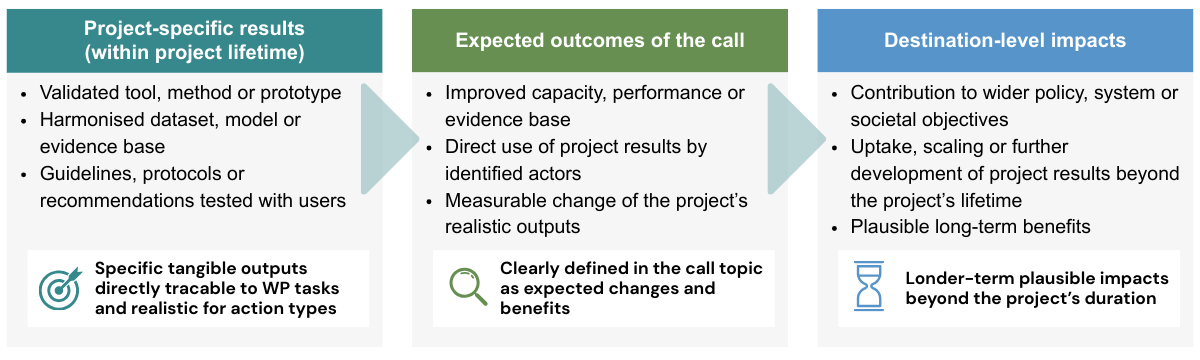
2. Think in pathways, not promises
Rather than listing benefits (“the project will improve…”, “the project will enable…”), effective Impact sections describe a sequence of cause and effect.
Example:
- Result: a validated method or prototype developed and tested during the project
- Uptake mechanism: piloting with specific users, integration into existing workflows or follow-up standardisation
- Beyond the project: adoption by third parties, further development through follow-up funding or use in policy processes
Each step should be plausible within the project’s duration and budget.
3. Be selective with dissemination, exploitation and communication measures
Under reduced page limits, long catalogues of standard activities (multiple conferences, website, social media content) weaken the proposal.
Example: Instead of listing ten dissemination activities, focus on:
- one or two key channels that directly reach the identified key stakeholders, and
- a small number of exploitation or uptake actions that clearly support the pathway described in Section 2.1.
Each major activity should answer a simple question: Who is this for, and how does it move the pathway forward?
4. Use impact summary tables only when they add clarity
With Section 2.3 now optional, include tables only if they genuinely help structure complex impact logics, for example, in projects with multiple result streams or heterogeneous user groups. Where the narrative already provides a clear and readable pathway, a table is unnecessary and can safely be omitted.
5. Avoid generic language and recycled impact text
Statements such as “the project will contribute to societal wellbeing” or “support EU competitiveness” only add value if they are clearly contextualised. Specific, modest claims that are traceable to project activities are consistently more credible than broad, aspirational language.
Example: Rather than claiming “societal impact”, specify which group benefits, how they benefit and through which concrete result or process.
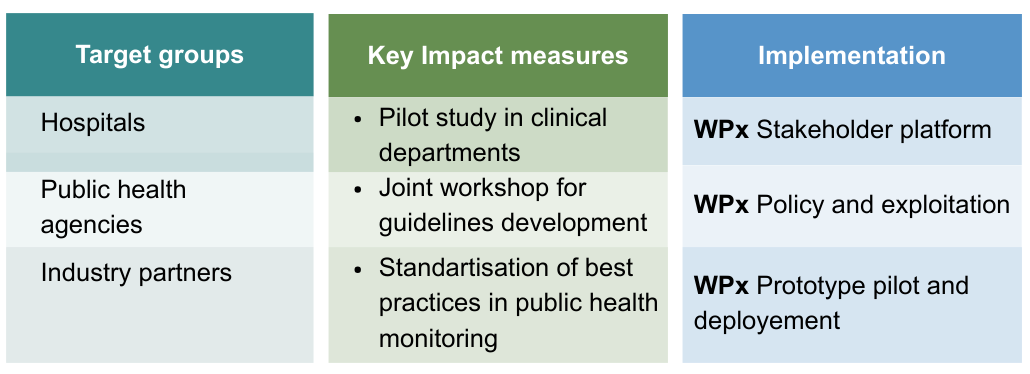
6. Ensure consistency across Impact and Implementation.
Evaluators cross-check Impact claims against Section 3. If an Impact pathway relies on stakeholder engagement, standardisation, policy dialogue or demonstrations, this must be visible in work packages, tasks, deliverables and allocated resources.
Example: If uptake depends on engagement with regulators or end users, this should appear explicitly in the work plan, not only in Section 2.
Looking for proposal support to strengthen your Impact section?
Under the streamlined 2026 Impact framework, writing a strong Impact section requires more than compelling ambition. It requires a clear understanding of how Section 2.1 and 2.2 are now expected to be structured, how impact pathways should be articulated and how communication, dissemination and exploitation measures must be prioritised under tighter page limits.
At accelopment, we support Horizon Europe consortia in designing and writing Impact sections that are fully aligned with the revised 2026 proposal template. We work hands-on with coordinators and partners to translate project results into credible pathways for uptake, use and further development and to ensure consistency between Impact ambitions and implementation choices. Beyond proposal preparation, we also act as a communication, dissemination and exploitation partner in funded projects. We are currently involved in dozens of ongoing Horizon Europe projects across Cluster 1 Health, Cluster 5 Climate, Energy and Mobility and Cluster 6 Food, Bioeconomy and Environment, supporting consortia in delivering, monitoring and reporting on Impact throughout the project lifecycle.
If you are preparing a Horizon Europe proposal and want to ensure that your Impact section is both compliant with the 2026 requirements and convincing for evaluators, we would be glad to discuss how we can support your proposal.