
MSCA 2025 DN – common weaknesses in the impact section and how to overcome them
3rd September 2025 at 10:14 am
The Impact section of a Marie Skłodowska-Curie Actions (MSCA) Doctoral Network (DN) proposal accounts for 30% of your final score. In this section, you must convincingly demonstrate the relevance of your proposed project, emphasising how you will achieve a sustainable impact for various stakeholders. Based on our extensive experience in reviewing and improving previously unsuccessful proposals, we have identified common weaknesses in the Impact section. In this blog, we will highlight these shortcomings and provide insights on how to avoid them as you prepare your DN proposal for the upcoming deadline on November 25, 2025.
Sustainability planning is too vague
Sustainability planning can often seem vague. Evaluators seek concrete mechanisms to ensure that the value of the DN extends beyond its funding period. In this section, you should outline specific measures to ensure the sustainability of the DN training activities. These measures could include integrating components of the network-wide training activities into local PhD programmes (including specific pathways), creating Massive Open Online Courses (MOOCs) to provide lasting and open access to developed training materials, and establishing follow-up collaborations through future projects and other initiatives.
Communication and dissemination activities are too general
Communication and dissemination activities are often too general. Many proposals focus their activities on the dissemination of results to the scientific community. However, both the EU and evaluators expect the communication and dissemination activities to engage with a variety of relevant stakeholders. A strong communication and dissemination plan should, therefore, include activities aimed at well-defined target audiences, with a clear purpose and key performance indicators.
Unclear exploitation and intellectual property management
Exploitation measures are often generic and disconnected from the actual research outcomes. Evaluators want to ensure that participants have a clear understanding of their expected outcomes and how they may be exploited, both commercially and non-commercially, in the future. The exploitation plan should outline specific strategies for all key results of the proposal, including well-defined plans for future uptake and potential protection of intellectual property.
Social and economic impact claims lack substance
Social and economic impact claims often lack substance. While researchers generally do well in articulating the potential scientific impact of their proposed projects, they often struggle to convey the economic and societal effects clearly. Generic statements about job creation, green innovation, or clinical impact, without supporting evidence or clear pathways, are unlikely to persuade evaluators. Applicants should provide a detailed explanation of how the project’s results will lead to tangible outcomes and long-term impact. A summary table or figure can help visualise the impact pathways.
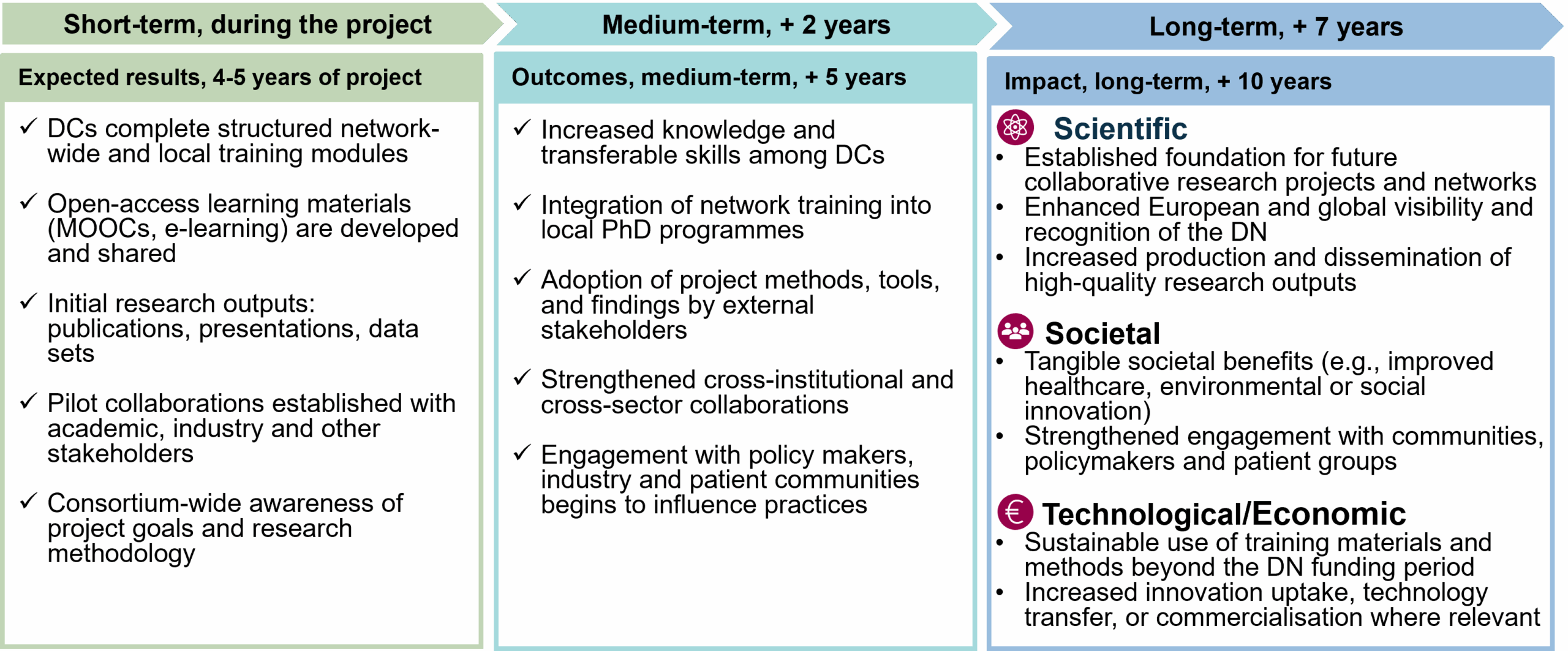
Need support with your impact section?
The impact section isn’t just about promoting your proposal to the evaluators. It’s about defining who benefits, how, and when. Evaluators are looking for maturity of thinking and clear pathways for long-term impact.
At accelopment, we have guided numerous MSCA DN consortia through successful submissions, helping new or previously unfunded DN proposals reach the required threshold and secure funding. As an Associated Partner in three Horizon Europe DNs currently in grant preparation (BioTransform, INT2ACT and PANIONS), seven ongoing DNs DarChem, MobiliTraIN, BREAKthrough, CONCISE, MITGEST, MIRELAI and SYNSENSO, as well as many H2020 ITNs, we at accelopment have gathered a great deal of practical experience in Proposal Writing, Project Management and Dissemination support as well as Transferable Skills Training all geared toward DNs. If you are interested in our support for your upcoming DN proposal, feel free to contact us.