
MSCA Doctoral Networks 2025 – success rates fall as competition intensifies
27th March 2026 at 1:11 pm
The European Commission has completed the evaluation of the 2025 MSCA Doctoral Networks (DNs) call, with applicants receiving their results on 25 March 2026. The outcome confirms what many in the MSCA community had anticipated: competition has tightened further, success rates have dropped again, and securing funding now requires an even stronger proposal than in previous years.
By the 27 November 2025 deadline, the European Research Executive Agency had received 1,616 proposals. Out of these, 141 proposals were invited for grant preparation, resulting in an overall success rate of just 8.8%. This is 1.7% below the 2024 rate and 3.2 points below the 2023 level, continuing a clear downward trend. The pressure is being driven by persistently high submission numbers, only limited budget growth, and a growing volume of resubmitted proposals competing across all panels.
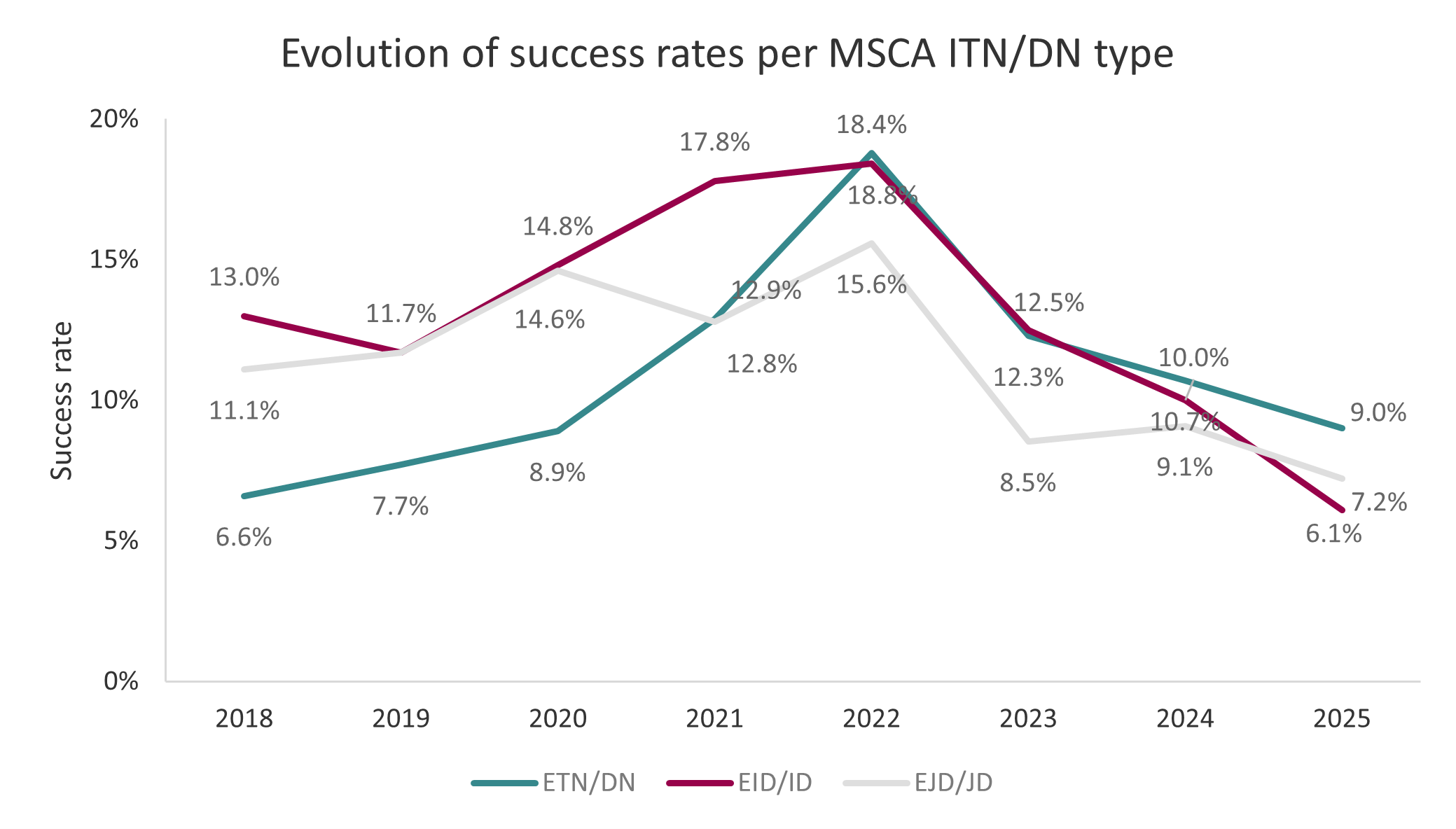
The European Commission will award a foreseen total of € 617.18 million for 128 standard DNs (€ 562.88 million), five Industrial Doctorates (IDs; € 19.7 million), and eight Joint Doctorates (JDs; € 34.6 million). The success rates across DN types follow a slightly different pattern compared to previous years, with standard DNs having the highest success rate (9.0%), followed by JDs (7.2%) and IDs (6.1%) (Figure 1).
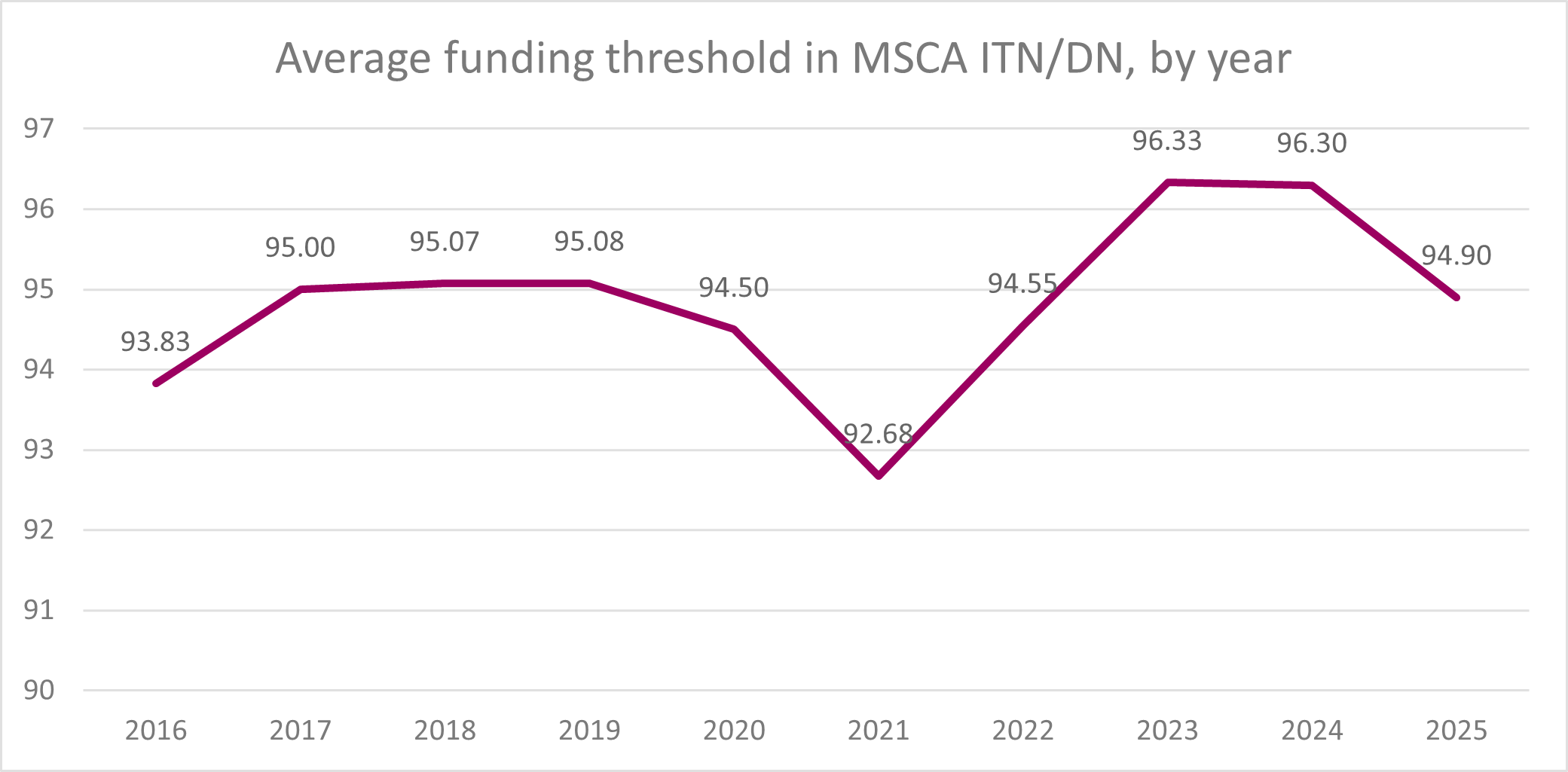
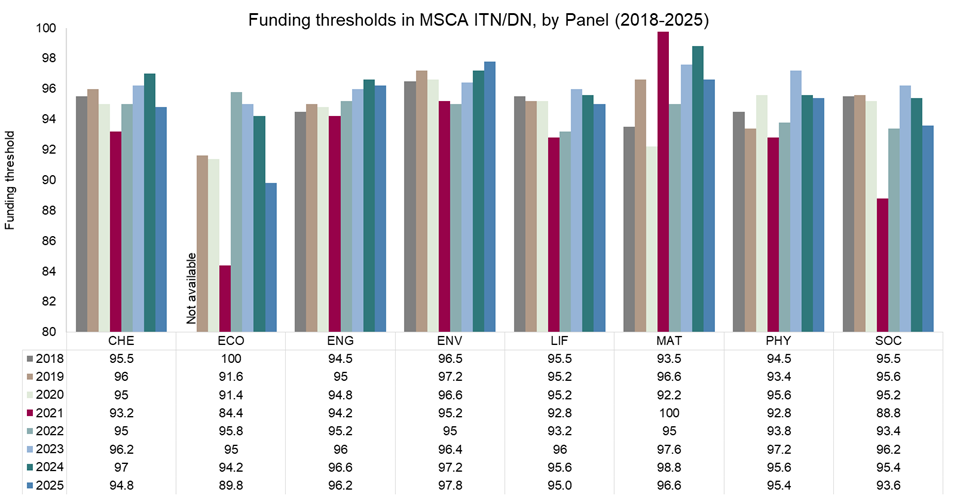
The distribution across scientific panels remains broadly consistent. Engineering and ICT (37.5%), Life Sciences (22.7%) and Chemistry (12%) continue to attract the highest number of proposals. Interestingly, most panels were less competitive than last year, with a decrease in cut-off scores across nearly all domains, including 2.2 points in Chemistry (CHE, 94.8), 4.4 in Economics (ECO, 89.8), 0.4 in Engineering (ENG, 96.2), 0.6 in the Life Sciences (LIF, 95), 2.2 in Mathematics (MAT, 96.6), 0.2 in Physics (PHY, 95.4), and 1.8 in Social Sciences (SOC, 93.6). Only the Environment panel (ENV) was more competitive than last year, with an increase of 0.6 points, reaching a cut-off score of 97.8. However, all panels remain highly competitive. The average funding threshold decreased compared to last year, reaching 94.9 (Figure 2). Consequently, many proposals scoring above 94 still did not reach the reserve list.
The data presented does not include proposals placed on the reserve list. Each year, a number of top-ranked proposals from this list are eventually invited for funding. Successful applicants can typically expect notification during the summer, following the conclusion of Grant Agreements with initially selected projects. For more detailed information about your ranking positions, you are encouraged to contact your local MSCA National Contact Point, who should have access to the ranking list.
Next deadline and professional support for your DN project
Has your proposal been unsuccessful, or are you planning to apply for the first time? The next MSCA Doctoral Networks call will open on 28 May 2026, with a deadline on 24 November 2026. If you intend to resubmit, please note that, should the rules remain unchanged, proposals that scored below 80 in the previous year will not be eligible. In an increasingly competitive environment, strong positioning and a well-structured proposal are more important than ever. Building on our DN track record, we are supporting four proposals that have been invited to grant preparation, five recently started Horizon Europe DNs (HEAL-4WARD, DT-HATS, PANIONS, INT2ACT and BioTransform) and several ongoing DNs (BREAKthrough, CONcISE, DarChemDN, MITGEST, MobiliTraIN and SYNSENSO and the ID MIRELAI). This builds on many years of experience supporting and partnering in DNs since FP7. We provide professional support in project management, communication, dissemination, and training, including transferable skills courses on research project management, science communication, funding opportunities, and grant writing. If you are interested in support for your DN proposal or newly funded DN project, please contact our DN experts.
If you are interested in our support for your DN proposal or newly funded DN project, contact our DN experts, Jacqueline Strehler and Jeanette Müller.
Want to stay informed?
We regularly publish blog posts on Doctoral Networks. You can subscribe to our blog updates in the main area of our blog.