
Successful MSCA Doctoral Networks proposals – what coordinators should prioritise during grant preparation
1st April 2026 at 3:52 pm
If your MSCA Doctoral Networks proposal has just been invited to grant preparation, congratulations! In a year marked by intense competition and a notably lower success rate, as analysed in our recent blog (MSCA Doctoral Networks 2025 – success rates fall as competition intensifies), reaching this stage is already a major achievement. But once the initial excitement settles, most coordinators quickly face the same reality: grant agreement preparation (GAP) is not just a formal step before signature. It is the moment when a promising proposal has to be translated into a project that can run smoothly from day one.
This transition is often underestimated based on our experience from dozens of DN GAPs. During proposal writing, many elements are presented in a coherent narrative and carefully structured tables. During grant preparation, those same elements need to be checked, confirmed, operationalised and, in some cases, revised. For example, there are some mandatory Deliverables in DNs that your REA Project Officer will request you to add, if not already included.
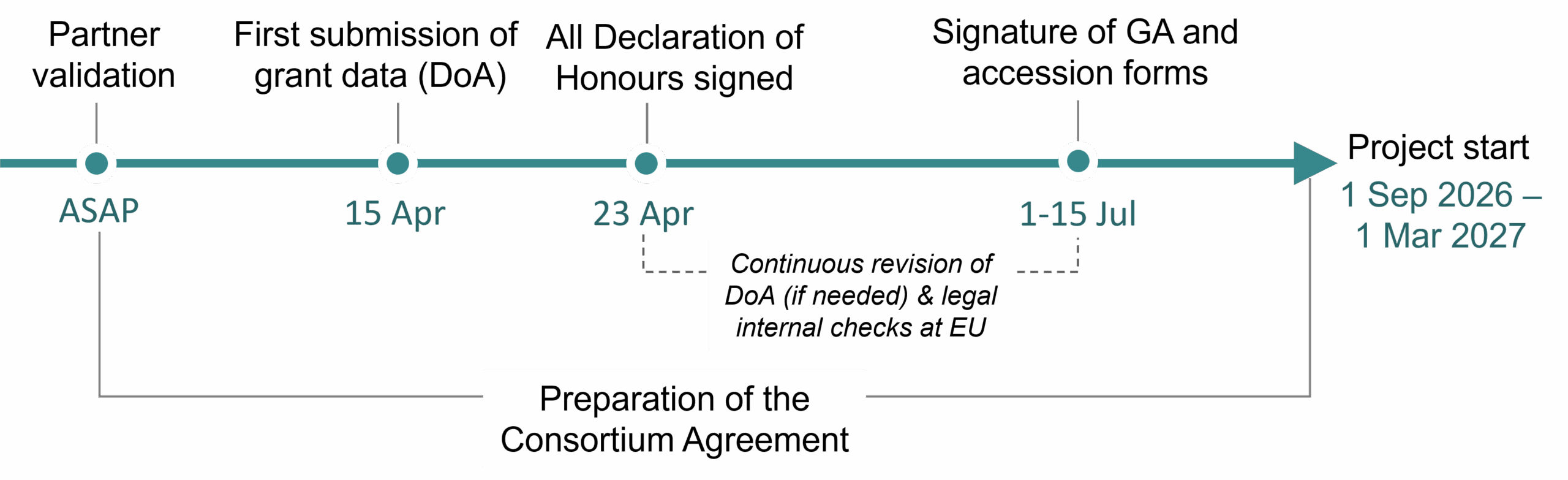
For MSCA-DN coordinators, this is also the point where administrative and communication-related challenges begin to surface more clearly. Recruitment planning, project governance and internal workflows all require attention very early on. We recommend organising a meeting with all beneficiaries at the start or during grant preparation and not to leave these aspects until after the project start.
Why GAP matters more than many consortia expect
The grant agreement (GA) defines the work the consortium commits to carry out, including the project activities, the doctoral candidates’ (DC) projects and rights and obligations. For multi-beneficiary grants like the MSCA-DNs, the coordinator is responsible for steering the process on behalf of the consortium and for submitting the required reports, deliverables and related documents through the grant management system on the Funding & Tenders (F&T) Portal.
In practice, this means GAP is the moment to test whether the consortium is ready to deliver what was promised. That includes questions such as:
- Are all Beneficiaries and Associated Partners still fully committed and available?
- Is there a practical approach for internal communication and decision-making procedures in place?
- Is the project start date compatible with the participating universities’ PhD programme schedule?
- Is the training programme clear enough to be implemented without confusion?
- Are recruitment responsibilities and timelines realistic?
- Has the consortium thought through who will prepare the early administrative and communication deliverables?
None of these issues is secondary. In DNs, the quality of implementation is closely tied to the DCs’ experience, the coherence of the training programme and the overall credibility of the network. A weak operational set-up can create avoidable pressure very early in the project.
What coordinators should prioritise during GAP?
Based on our experience with DNs, there are a few areas that deserve particular attention during grant preparation.
- First, confirm the operational commitment of all partners. Even if the proposal was strong, practical circumstances may have changed since submission. It is better to identify any gaps now than after the grant agreement is signed.
- Second, set up the administrative backbone of the project early. This includes management templates, internal planning tools, document responsibilities, meeting structures and reporting workflows. Early structure reduces the burden on the coordinator later.
- Third, review whether the communication and dissemination approach is implementation-ready. Ask whether the consortium has the materials, guidance and support needed to deliver the activities already described in the proposal.
- Fourth, think carefully about external support. GAP is often the right moment to bring in partners or service providers who can strengthen project operations without overloading the scientific beneficiaries. This is particularly relevant for communication, dissemination, training support and project administration since these tasks require substantial efforts during the project implementation.
How we support newly funded DN projects
At accelopment, we support MSCA-DNs not only during proposal preparation, but also during grant preparation and project implementation. Depending on the consortium’s needs, we do and can contribute as an Associated Partner or service provider in project administration, communication and dissemination, and transferable skills training. This includes transferable skills courses, such as science communication and grant writing training, communication materials and guidelines, recruitment-related support, administrative deliverables, reporting preparation and several other support tasks.
If your MSCA DNs proposal has been invited to grant preparation and you are now planning the next steps, feel free to get in touch. We would be happy to discuss how we can support your consortium during GAP and beyond, including as an Associated Partner for administration support, communication, dissemination and transferable skills training. And you can benefit from our long-lasting DN track record, including four Horizon Europe DN proposals that have been invited to grant preparation, five recently started DNs (HEAL-4WARD, DT-HATS, PANIONS, INT2ACT and BioTransform) and several ongoing DNs (BREAKthrough, CONcISE, DarChemDN, MITGEST, MobiliTraIN and SYNSENSO and the ID MIRELAI).
Want to stay informed?
We regularly publish blog posts on Doctoral Networks. You can subscribe to our blog updates in the main area of our blog.