
Preparing an MSCA 2025 DN proposal until 25 November 2025 – how to make the impossible possible
30th September 2025 at 1:51 pm
With less than two months until the MSCA Doctoral Networks (DN) deadline on 25 November 2025, many researchers are wondering whether it is even worth trying to pull together a proposal. The requirements seem overwhelming with 34 pages of carefully argued text, a consortium to coordinate across countries and sectors, a training programme to design and all the mandatory tables, deliverables and risks to complete. At first glance, the timeline looks impossible. But our experience at accelopment from many years of DN writing support shows that with the right priorities, it is still very much possible.
Scientific excellence
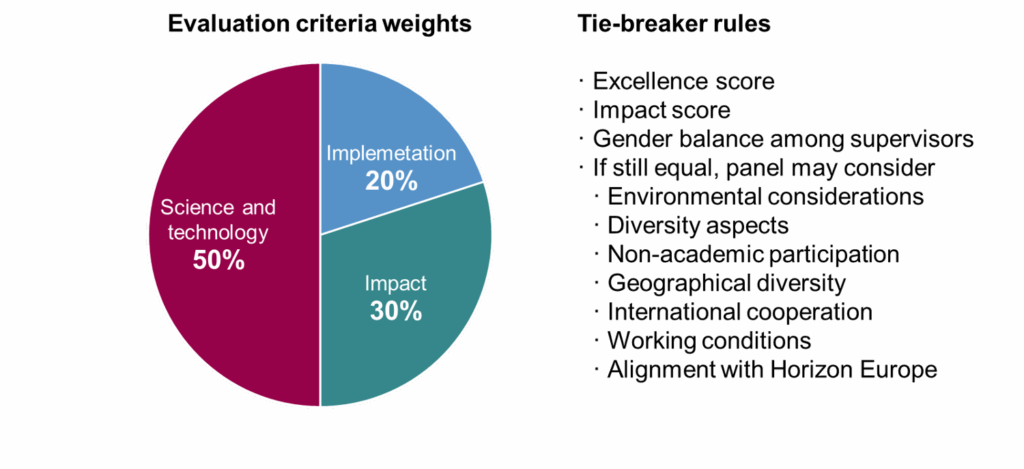
It is not enough to describe an exciting piece of science. Evaluators expect a tightly integrated research and training programme that delivers real European added value. The Excellence section alone accounts for half of the score, and here vague objectives or loosely connected projects will not pass. Clear, SMART objectives are essential, i.e. specific, measurable, achievable, relevant, and time-bound. Each doctoral candidate project must not only be feasible within 36 months but also contribute visibly to the overall programme. This year’s template shift, which places these projects in chapter 1.1 and requires a narrative description, can help applicants showcase the coherence of their network from the start.
Complementary training
Training is equally decisive. DNs are, above all, about preparing the next generation of researchers, so the proposal must go beyond the science. Transferable skills, such as communication, entrepreneurship and other generic skills, need to be woven into the programme alongside advanced scientific training. Evaluators notice when these are treated as an afterthought. The recently published RADIANCE DN Handbook 2025 stresses that the training plan should complement local PhD programmes, not duplicate them, demonstrating how the network adds real value for each doctoral candidate
Realistic impact
If Excellence sets the scientific and training ambition, Impact is where many proposals stumble. Too often, sustainability is described in vague terms or exploitation reduced to generic statements about intellectual property. Evaluators are looking for more concrete answers: how will the project’s value live on after funding ends? Will network-wide training activities be embedded in local PhD curricula? Could Massive Open Online Courses (MOOCs) or other open resources provide lasting benefits? Equally important is to move beyond the academic audience. Policymakers, industry and civil society are audiences to be considered in a communication and dissemination plan that defines not just what you will do but why and for whom, ideally with measurable indicators. And when it comes to societal and economic impacts, generic promises of job creation or innovation ring hollow without evidence. Clear pathways and tangible examples are far more convincing.
Planned implementation
Implementation, while weighted at 20%, often tips the balance in a competitive call. Here, small details can cost valuable points of the evaluation score. Deliverables and milestones, for instance, should not all cluster at the project’s end. Early scientific outputs give evaluators confidence that progress will be monitored and adjusted along the way. Risks, too, must be taken seriously. A superficial list will not do; each risk needs a credible mitigation plan, tailored to the science and the structure of the network. Partner roles should be crystal clear. A consortium matrix showing who contributes to which aspect, such as research, training, supervision, secondments, can quickly demonstrate complementarity. Even supervision experience benefits from being quantified by the number of PhDs previously supervised, courses delivered, training activities organised. Precision here signals reliability.
A writing strategy and professional support help under tight deadlines
So how can all this be achieved in less than eight weeks? The RADIANCE DN Handbook 2025 suggests breaking the task into parallel work streams: one small team focuses on drafting Excellence, another on training and Impact, while coordinators ensure all pieces fit together. Weekly progress calls keep the momentum, and internal drafts are circulated early rather than waiting until the last moment. Using templates for doctoral candidate tables, milestones, and training overviews can save time while ensuring compliance with the template.
At accelopment, we have supported numerous DN proposals on tight timelines, whether first-time submissions or resubmissions, helping consortia reach or surpass the funding threshold. As Associated Partner in the new BioTransform, INT2ACT, PANIONS and DT-HATS DNs, and as part of seven ongoing DNs, we bring in our expertise and help you get there efficiently.
If you are determined to submit a DN proposal this year, don’t let the short timeline hold you back. With the right focus and expert guidance, the “impossible” can become possible. Contact us for either a final review of your draft or full writing support.