
Horizon Europe’s Cluster 3 Security Work Programme 2026 – Proposal tips for the next proposal submission deadline in less than 3 months
11th August 2026 at 10:37 am
European funding for security research and innovation is essential for addressing evolving threats, including cybercrime, terrorism and natural and human-made disasters. Through Horizon Europe, the EU’s flagship research and innovation programme, researchers and innovators gain access to funding that strengthens Europe’s security and resilience in line with the EU Security Union Strategy.
With EUR 1.596 billion allocated to Pillar 2, Cluster 3: Civil Security for Society over 2021-2027, Horizon Europe supports projects that strengthen crisis preparedness, improve civil security capabilities and protect European citizens. The 2026-2027 Civil Security for Society Work Programme was adopted by European Commission Decision on 11 December 2025.
Change of focus from 2025 to 2026 Cluster 3 Security Work Programme
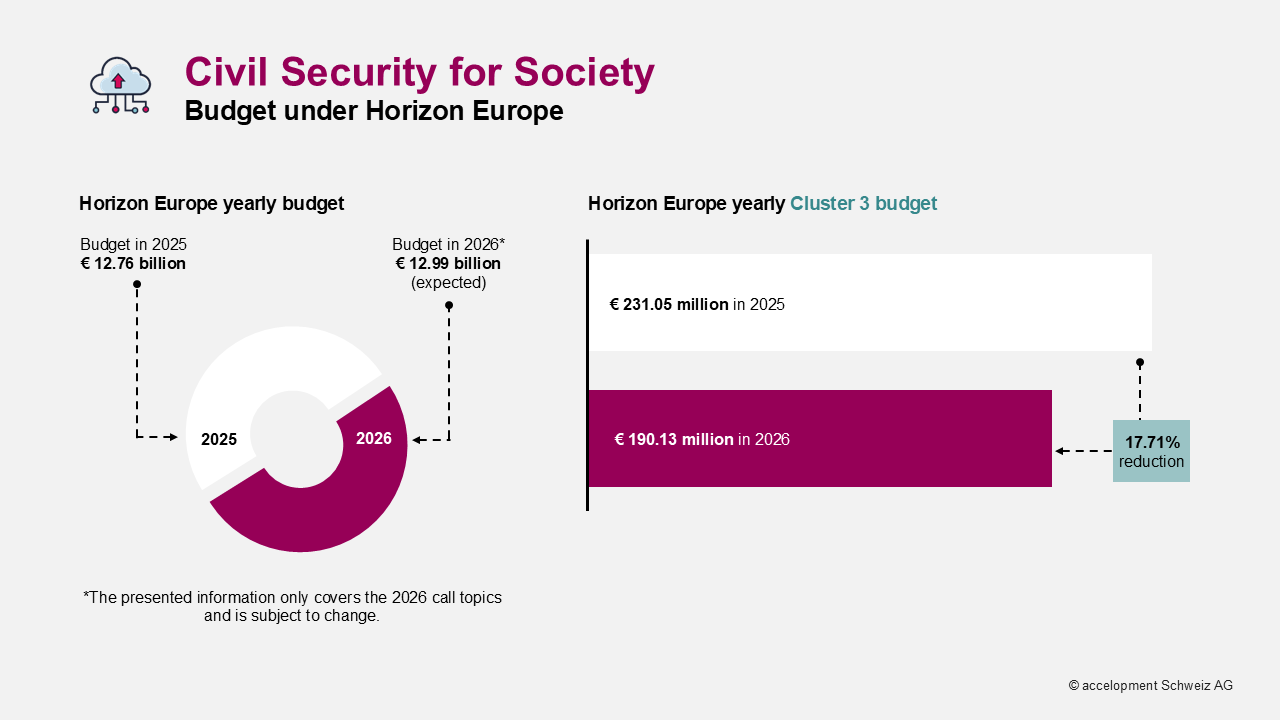
The 2026 Work Programme reflects the EU’s latest security priorities, including the ProtectEU European Internal Security Strategy, the Preparedness Union Strategy and the 2024-2029 Commission Political Guidelines. Compared with the 2025 Work Programme, it places greater emphasis on demand-driven innovation, market uptake and procurement-based funding, while cybersecurity is now implemented through an indirectly managed action under the European Cybersecurity Competence Centre (ECCC).
The 2026 calls – funding opportunities across five destinations
The 2026 Cluster 3 calls make around EUR 187 million available: EUR 131 million for the direct Civil Security for Society topics and EUR 56.2 million for cybersecurity. Once other actions are included, the total 2026 budget rises to approximately EUR 190.13 million. The direct Civil Security for Society call opened on 6 May 2026 and closes on 5 November 2026 at 17:00 Brussels time. Cybersecurity topics managed by the ECCC close earlier, on 15 September 2026.
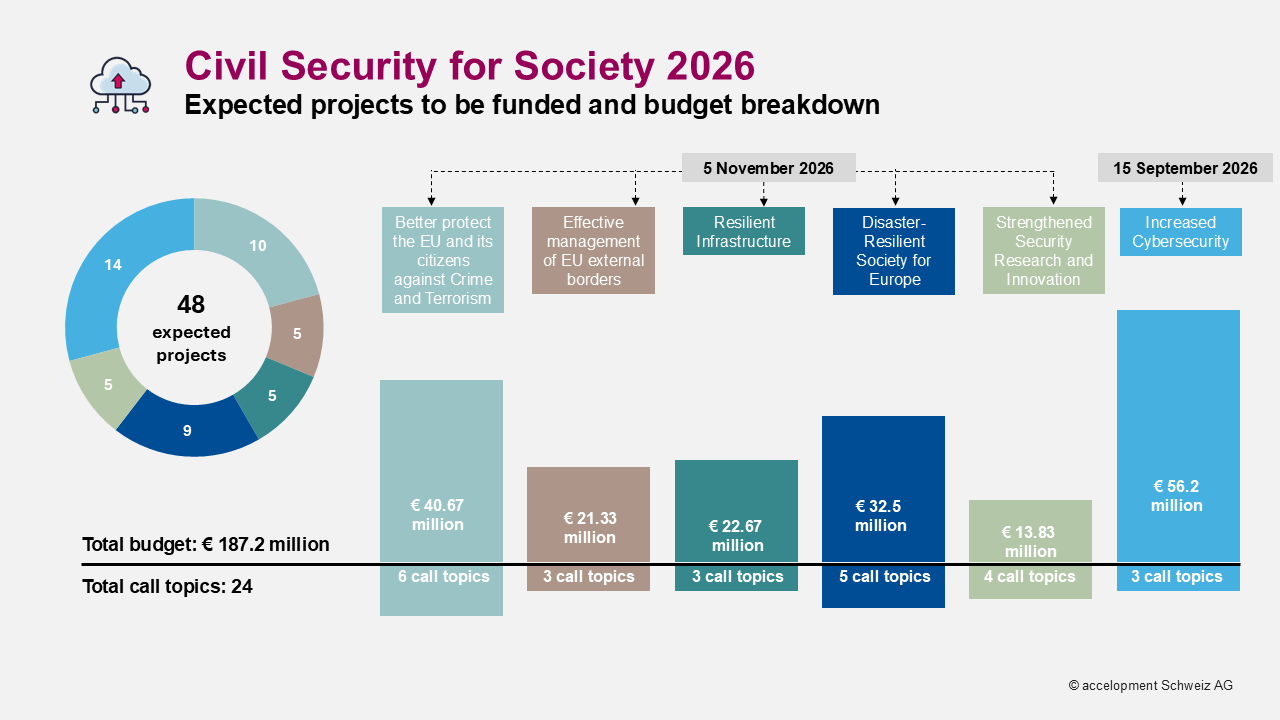
As outlined in the Work Programme, the 2026 Civil Security for Society call is structured around five direct destinations, with cybersecurity addressed through an indirectly managed action implemented by the ECCC. The 2026 call includes 21 direct topics across 5 destinations. This year, all 21 direct call topics share the same deadline: 5 November 2026. You will find the full list of 2026 topics in the tables below.
With three months remaining, applicants should now be moving beyond concept development and concentrating on eligibility, consortium roles, implementation planning, budgeting and proposal integration. Below, we share several practical points that can make a decisive difference.
Proposal preparation: Practical tips from successful security writers
- Understand the type of action
The 21 direct topics use five different action types. Each has implications for consortium design, partner roles, reimbursement and project implementation.
| Type | Cost and funding structure |
| Research and Innovation Actions (RIA) | funded at 100% of eligible costs |
| Innovation Actions (IA) | cover 70% of eligible costs for for-profit entities and 100% for non-profit organisations. |
| Coordination and Support Actions (CSA) | funded at 100% of eligible costs |
Pre-commercial Procurement (PCP) and Public Procurement of Innovation (PPI) topics have their own logic and require strong participation from public procurers and practitioners.
- Prepare carefully for lump sum funding
Lump sum funding now applies to almost all 2026 topics. While it represented just under half of the 2025 Cluster 3 call budget, it accounts for approximately 95.8% of the 2026 budget. Under lump sums, the proposal must present a credible distribution of work, resources and costs at work package level. Budgeting should therefore be developed alongside the work plan, not added at the end. Each partner’s resources must be proportionate to its tasks, responsibilities and expected contribution.
- Match the proposal to the required technology readiness level
Technology Readiness Levels, or TRLs, indicate how mature the project results should be by the end of the action. Across the 2026 topics, TRLs range from 4 to 8:
- TRL 4-5 topics generally expect validation in a laboratory or relevant environment and are often Research and Innovation Actions.
- TRL 6-8 topics usually expect demonstration in relevant or operational environments and are often Innovation Actions.
- Higher-TRL projects require mature technologies, realistic testing conditions and strong practitioner or end-user involvement.
- The work plan, consortium and budget should all reflect the target maturity level.
Applicants should check the required TRL early and explain clearly how the project will progress from its starting point to the expected level by the end of the grant.
- Give practitioners meaningful roles
Practitioner involvement remains a key element, same as in the previous security calls. Eligibility conditions vary across topics and should be checked carefully. Depending on the topic, proposals may need to include Police Authorities, Border or Coast Guard Authorities, Customs Authorities, civil protection authorities, critical infrastructure operators, NGOs, Civil Society Organisations, SMEs, practitioners or public procurers from several EU Member States or Associated Countries. Where practitioner participation is an eligibility condition, proposals must include the relevant “Information about security practitioners” or “Eligibility information about practitioners” table provided in the submission system.
Practitioners should have a meaningful role in defining needs, validating requirements, testing solutions and assessing project outcomes. At the same time, their workload must remain realistic alongside their operational responsibilities. Many topics also require a mid-term deliverable in which practitioners assess the project’s results and progress. This should be reflected explicitly in the work plan.
- Plan for future engagement with the wider European security ecosystem
Many topics also refer to engagement with EU agencies during implementation, such as Europol, Frontex, eu-LISA, the EU Drugs Agency or CEPOL during project implementation. While topics clearly state that these agencies should not be contacted during proposal preparation unless the topic text or call conditions indicate otherwise, it is important to plan for future cooperation with them at the proposal stage already be it for event attendance, activities, communication and dissemination plan. For more information on relevant organisations and potential cooperation pathways, see our blog on the European security research ecosystem.
- Monitor possible amendments
Amendments to the 2026-2027 Work Programmes are expected in autumn 2026. No Cluster 3 amendment has been published to date, but applicants can monitor amendments on the Search for committees – Comitology Register and should check the latest official version of the Work Programme and the relevant call page before submission.
The 2027 calls – preparing early for the next opportunity
Did not find a suitable topic in 2026, or need more time to mature the concept and consortium? The 2027 Civil Security for Society call provides another strong opportunity. It opens on 5 May 2027 and closes on 4 November 2027, with EUR 129.50 million available across 17 direct topics in the same five destinations. A separate ECCC cybersecurity call provides EUR 71.80 million and closes on 15 September 2027.
The 2026-2027 Work Programme is the final Cluster 3 Work Programme under Horizon Europe, which runs until the end of 2027. The structure, budget and detailed content of civil security research funding under the next EU Framework Programme are not yet confirmed. This means that organisations with strong project ideas should consider the available 2026 and 2027 calls rather than assume that equivalent opportunities will continue after Horizon Europe.
Horizon Europe security initiatives – our team helps you turn your ideas into projects
At accelopment, we have extensive experience in securing EU funding for research and innovation projects such as the successful CapCell Security proposal which scored 15 out of 15 in the 2024 Horizon Europe Cluster 3 calls. With a strong track record in Horizon Europe projects, our team of experts supports researchers, companies and institutions throughout the entire funding process – from strategic grant planning, to proposal writing, project management and communication and dissemination. Based on our deep knowledge of Horizon Europe funding opportunities, we help our partners maximise their chances of success in securing European research grants and are involved in several successfully funded projects. We are well-versed in navigating EU requirements and supporting diverse consortia and look forward to assisting researchers in the upcoming call.
Horizon Europe 2026 security call topics – key facts for you to know*
The EU is investing in security research to combat crime, enhance cybersecurity, strengthen border control, and improve disaster resilience. The tables below outline key funding calls by Destination, supporting innovations from AI-driven cybersecurity to crime prevention and crisis response.
Whether you’re advancing forensic tools, improving border surveillance, or boosting critical infrastructure resilience, this is your roadmap to securing funding for cutting-edge solutions!
| Destination: Better protect the EU and its citizens against Crime and Terrorism | ||||
| Call topic | Type of Action | Budget (EUR million) | Budget/ project | Deadline |
| HORIZON-CL3-2026-01-FCT-01: Improving capabilities of law enforcement to counter climate-related challenges | RIA | 8.00 | Around 4.00 | 05/11/2026 |
| HORIZON-CL3-2026-01-FCT-02: Open topic on preventing and countering the misuse of emerging technologies for criminal purposes, including issues related to lawful access to data | RIA | 9.00 | Around 4.50 | 05/11/2026 |
| HORIZON-CL3-2026-01-FCT-03: Missing persons: prevention and investigation | IA | 5.00 | Around 5.00 | 05/11/2026 |
| HORIZON-CL3-2026-01-FCT-04: Crime prevention approaches, online and off-line, tackling the nexus between addictions and crime | RIA | 6.00 | Around 3.00 | 05/11/2026 |
| HORIZON-CL3-2026-01-FCT-05: Enhancing the security of citizens against terrorism and lone-actor violence in confined spaces such as schools | IA | 9.67 | Around 4.835 | 05/11/2026 |
| HORIZON-CL3-2026-01-FCT-06: Prevention and mitigation of misuse of synthetic biology for bioterrorism purposes | RIA | 3.00 | Around 3.00 | 05/11/2026 |
| Destination: Effective management of EU external borders | ||||
| Call topic | Type of Action | Budget (EUR million) | Budget/ project | Deadline |
| HORIZON-CL3-2026-01-BM-01: Advanced border surveillance and situational awareness | IA | 12.00 | Around 6.00 | 05/11/2026 |
| HORIZON-CL3-2026-01-BM-02: Accessible and available travel facilitation | IA | 8.00 | Around 4.00 | 05/11/2026 |
| HORIZON-CL3-2026-01-BM-03: Reliability of age assessment methods in the context of security and border management | CSA | 1.33 | Around 1.33 | 05/11/2026 |
| Destination: Resilient Infrastructure | ||||
| Call topic | Type of Action | Budget (EUR million) | Budget/ project | Deadline |
| HORIZON-CL3-2026-01-INFRA-01: Tools and processes to support stress tests of critical infrastructure | IA | 9.67 | Around 4.835 | 05/11/2026 |
| HORIZON-CL3-2026-01-INFRA-02: Security challenges of the green transition in urban und peri urban areas | RIA | 4.00 | Around 4.00 | 05/11/2026 |
| HORIZON-CL3-2026-01-INFRA-03: Targeted innovative capabilities for the resilience of critical entities to natural and human-induced disasters, including hybrid scenarios | IA | 9.00 | Around 4.50 | 05/11/2026 |
| Destination: Disaster-Resilient Society for Europe | ||||
| Call topic | Type of Action | Budget (EUR million) | Budget/project | Deadline |
| HORIZON-CL3-2026-01-DRS-01: Designing new ways of risk awareness and enhanced disaster preparedness | RIA | 6.00 | Around 3.00 | 05/11/2026 |
| HORIZON-CL3-2026-01-DRS-02: Multi-hazard approach and cumulative / cascading impacts | IA | 8.00 | Around 4.00 | 05/11/2026 |
| HORIZON-CL3-2026-01-DRS-03: Development of innovative tools, processes, equipment and technologies through responses to disasters and emergencies for search and rescue in hazardous conditions | IA | 8.00 | Around 4.00 | 05/11/2026 |
| HORIZON-CL3-2026-01-DRS-04: Open topic on driving innovation uptake of disaster risk solutions | IA | 6.00 | Around 3.00 | 05/11/2026 |
| HORIZON-CL3-2026-01-DRS-05: Climate security and civil preparedness: new ways to develop pre- and post-crisis climate-change related scenarios for a more resilient Europe | IA | 4.50 | Around 4.50 | 05/11/2026 |
| Destination: Strengthened Security Research and Innovation | ||||
| Call topic | Type of Action | Budget (EUR million) | Budget/project | Deadline |
| HORIZON-CL3-2026-01-SSRI-01: Open topic on supporting disruptive technological innovations for civil security | RIA | 3.00 | Around 1.50 | 05/11/2026 |
| HORIZON-CL3-2026-01-SSRI-02: Demand-led innovation in security | PCP | 5.83 | Around 5.83 | 05/11/2026 |
| HORIZON-CL3-2026-01-SSRI-03: Public procurement of innovation for security | PPI | 2.00 | Around 2.00 | 05/11/2026 |
| HORIZON-CL3-2026-01-SSRI-04: Development of ecosystem and next-generation capabilities for a secured European Critical Communication System in civil security | IA | 3.00 | Around 3.00 | 05/11/2026 |
| Destination: Increased Cybersecurity, implemented via ECCC | ||||
| Call topic | Type of Action | Budget (EUR million) | Budget/project | Deadline |
| HORIZON-CL3-2026-02-CS-ECCC-01: Approaches and tools for security in software and hardware development and assessment | RIA | 20.00 | 3.00 to 4.00 | 15/09/2026 |
| HORIZON-CL3-2026-02-CS-ECCC-02: Enhancing the Security, Privacy and Robustness of AI Models and Systems (SecureAI) | IA | 21.20 | 3.00 to 4.00 | 15/09/2026 |
| HORIZON-CL3-2026-02-CS-ECCC-03: Advanced cryptographic schemes and High-Assurance high-speed cryptographic implementations | RIA | 15.00 | 2.00 to 3.00 | 15/09/2026 |
* This information has been extracted from the published Horizon Europe Work Programme 2026-2027, Part 6: Civil Security for Society. While the Work Programme is no longer a draft, call opening dates, deadlines and budget amounts may still be subject to the conditions stated in the Work Programme, including possible opening or deadline adjustments by the responsible authority and budget availability. accelopment cannot be held responsible for changes made by the European Commission or the ECCC after publication.