
Budget planning and work package design in Horizon Europe lump sum proposals
9th March 2026 at 11:36 am
Lump sum funding has become a common feature for many projects in Horizon Europe. In fact, about 50% of the 2026 call topics are for lump-sum projects. According to the EU’s official Funding & Tenders portal, it reduces administration and makes the programme simpler. This might be partially true for the implementation phase of a running project, where lump sum funding removes the need for detailed financial reporting. But this is only one side of the coin. On the other side, lump sum funding does not make proposal preparation easier as it requires more detailed upfront planning than funding based on actual costs. To tackle this challenge, we have some tips for you.
How lump sum funding works
For each work package (WP), the estimated costs of all partners are aggregated and converted into a single lump sum amount. This amount is paid to all involved WP partners during the project implementation once the WP has been completed in full. This means that at proposal submission, all WP costs must already be fully defined and the Excel lump sum budget file must be fully aligned with Part B. This Excel file is provided through the EU Funding and Tenders Portal, its upload is mandatory and it requires detailed cost estimations for each beneficiary and affiliated entity, WP and cost category.
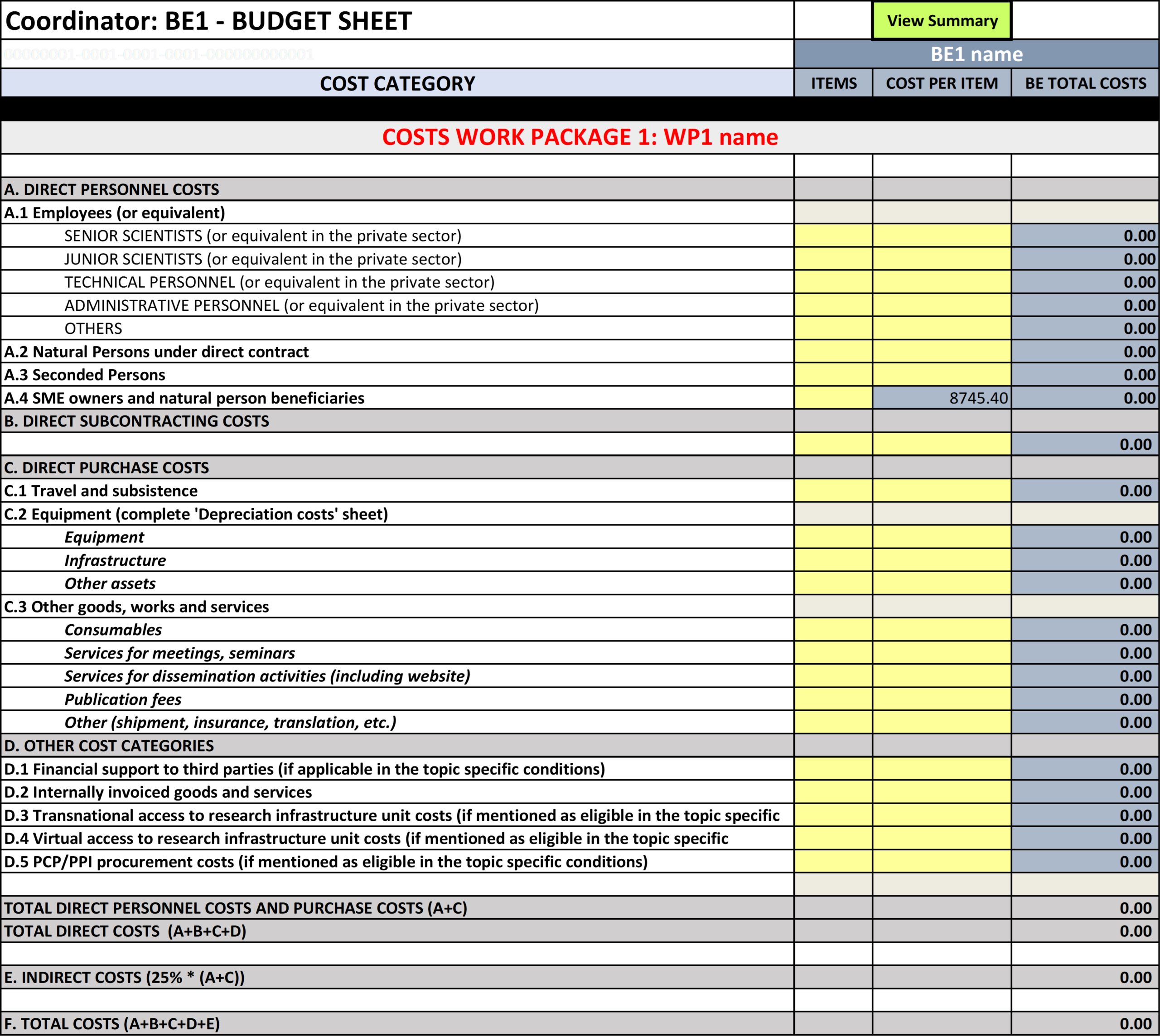
Despite the simplified payment mechanism, all cost categories remain the same and in practice, this is where many consortia struggle. The official Excel budget file works reliably, but is fully protected and not very user-friendly. With many beneficiaries and a long list of work packages (see WP splitting below), it quickly becomes difficult to populate, track cost categories, and make adjustments without losing oversight. Iterating the budget while keeping everything consistent is time-consuming and error-prone.
This is exactly why, at accelopment, we`ve developed a specific lump sum proposal financial template. It allows partners to plan their budgets in a clear and structured way, track changes throughout proposal preparation and to generate useful statistics such as the budget distribution by country or organisation type. Most importantly, it makes the completion of the European Commission’s lump sum Excel template much faster and far more reliable.
Work package design – timing, splitting and completion
Since lump sum payments are triggered only once a work package is completed, WP structuring has direct budget and cash-flow implications. This is not something that can be resolved at the end of proposal writing. WP duration, splitting, and partner involvement must already be reflected consistently in the budget. The European Commission explicitly recommends splitting long-running WPs, such as project management, dissemination or clinical trials, along reporting periods. Doing so improves cash flow, reduces implementation risk and makes payment easier to manage. From a budgeting perspective, it also means that personnel effort and other costs must be redistributed across multiple WPs in a controlled and traceable way.
When WPs are split, the same tasks may legitimately appear in more than one WP, for example, recurring project management activities. A template that tracks effort and costs per WP allows these repetitions to be handled transparently, without losing oversight or creating inconsistencies between Part B and the Excel budget file.
Hence, we recommend that applicants ensure that:
- All WPs are fully defined at proposal stage and already reflected in the budget
- Each WP is substantial and outcome-oriented, not a single task
- WP duration aligns with reporting periods and financial workflow
- WP completion can be assessed unambiguously, using milestones and deliverables
Our experience shows that incomplete or vaguely defined WPs often go hand in hand with weak budget coherence, resulting in major observations in the evaluation summary reports. Both are frequently flagged in lump sum evaluations.
Personnel costs, staff categories and the Horizon dashboard
Personnel costs are typically the largest budget component not only in lump sum proposals. Evaluators, therefore, look closely at how these costs are allocated and calculated. To support their assessment, evaluators rely on the Horizon dashboard for lump sum evaluations. This tool benchmarks personnel costs by country and organisation type, showing cost distributions that typically focus on the 20th to 80th percentiles. It allows evaluators to identify personnel costs that appear unrealistic or poorly justified.
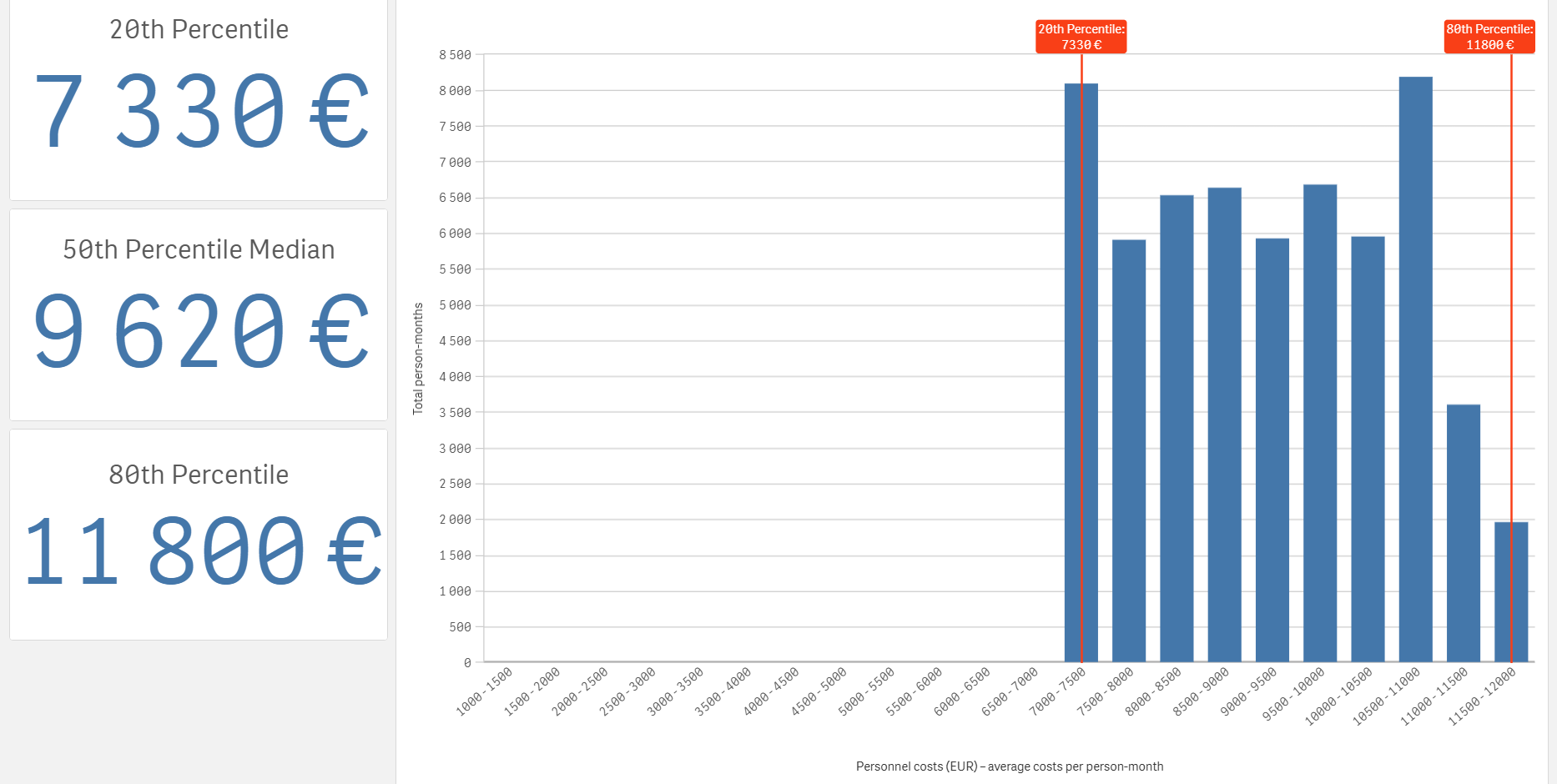
For applicants, this means it is important to use a budgeting tool that clearly shows who is working on what, and for how long. A structured template (like ours) helps you see the number of person-months for each Work Package (WP) and for each project partner, as well as all other cost categories. This makes it much easier to check that everything makes sense, compare values, and spot inconsistencies before copying the numbers into the European Commission’s Excel budget file.
A trusted partner in Horizon Europe research and innovation projects
At accelopment, we have supported numerous Horizon Europe projects across all research domains and funding instruments successfully, including those funded through lump sum grants. Our team combines in-depth knowledge of EU funding rules with hands-on experience in proposal preparation, budgeting, and project implementation. We assist applicants in navigating the specific requirements of lump sum funding, from structuring work packages to aligning with evaluation criteria. Let’s collaborate to turn your innovative ideas into successful projects!

Andreia Cruz
Research & Innovation Project Manager

Dr. Johannes Ripperger
Research & Innovation Manager