
How to position a strong proposal under EIC Pathfinder Challenges 2026
2nd March 2026 at 11:51 am
The EIC Pathfinder Challenges are an instrument designed to steer high-risk, high-gain research towards a small number of strategically defined technology areas. As the Pathfinder Challenges support very early-stage research at TRL 1 to 3-4, this means that projects need to be designed to reach up to proof of concept or laboratory validation of a breakthrough technology. They are based on clearly defined objectives in the EIC Work Programme and aim to build a portfolio of complementary projects that explore different scientific and technological approaches towards a common goal.
In 2026, Pathfinder Challenges continue to target areas where Europe seeks long-term technological leadership and systemic breakthroughs, combining scientific ambition with a strong strategic orientation. For applicants, this implies that success depends not only on the novelty of the research idea, but also on how convincingly the proposal contributes to the specific Challenge and fits within a broader portfolio logic. With the deadline on the 28th October 2026, there appears to still be plenty of time to put together a strong consortium and to ensure your Pathfinder Challenge proposal remains competitive. However, to compose a strong multidisciplinary consortium with the best-suited partners often requires more time than planned. Hence, we would like to share our experience and the latest information on this exciting EIC instrument here.
Why the EIC Pathfinder Challenges are a unique opportunity
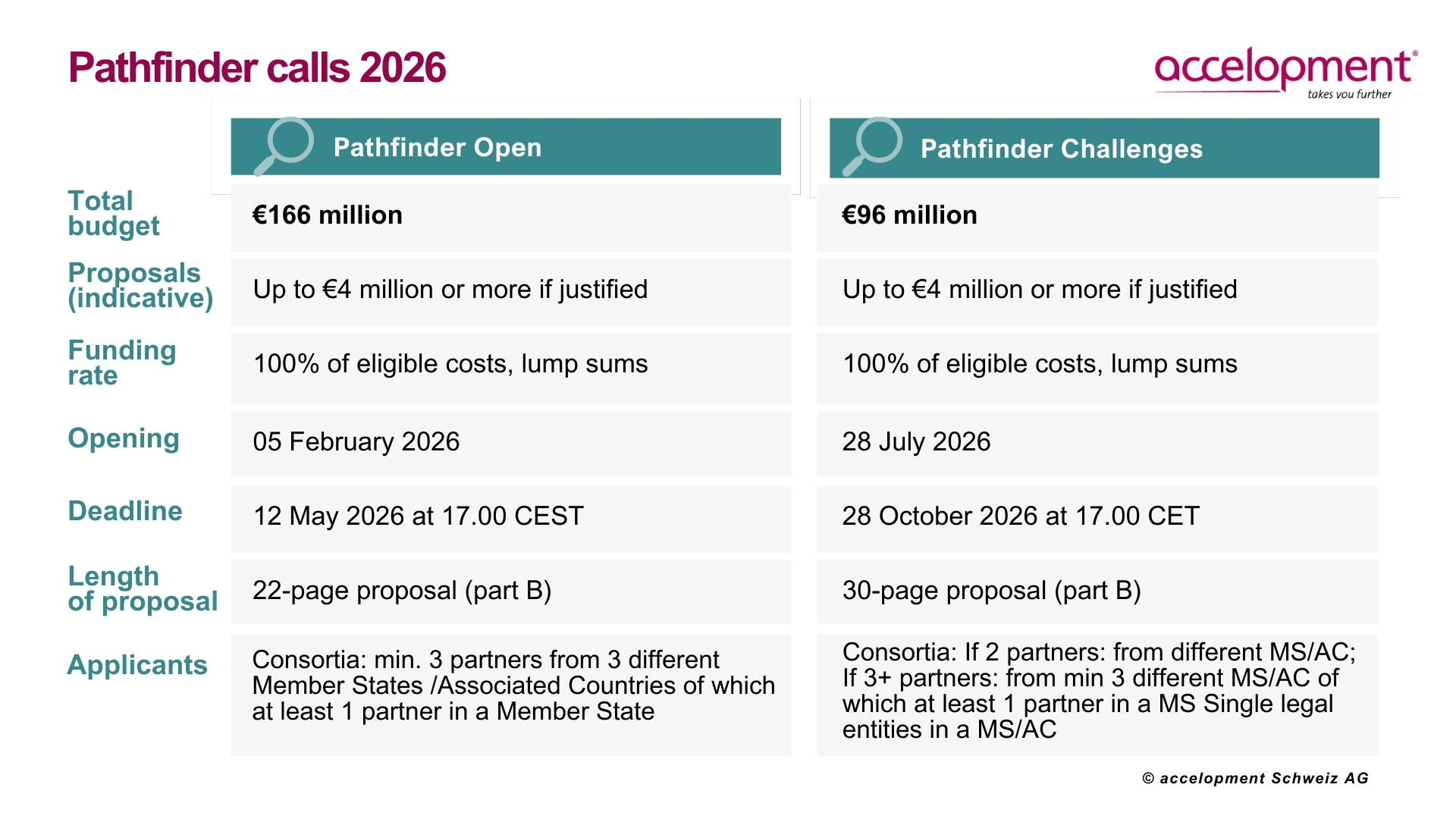
Unlike the Pathfinder Open, which supports projects in any field of science, technology or application without predefined thematic priorities, Pathfinder Challenges support coherent portfolios of projects within predefined thematic areas with the aim of achieving specific objectives for each Challenge. With an expected budget of up to € 4 million per project, the Pathfinder Challenges are deliberately narrow in scope, and this level of specificity can initially feel discouraging. However, this should be seen as an opportunity to compete in a less crowded space, where strong alignment and focused ambition are rewarded.
What are your chances of success in the EIC Pathfinder Challenges?
The numbers speak for themselves. In 2024, the Pathfinder Open call attracted 1,110 proposals, while the Challenges call received only 401 submissions, despite operating with a very similar overall budget (€ 138,1 and € 119,9 million, respectively), which resulted in twice the success rate for the Challenges call. This imbalance will probably become even more pronounced when the 2025 Challenges results are out. Last year, the Open call reached a record 2,087 proposals, competing for €142 million shared across just 44 funded projects. In 2025, the EIC received 667 project proposals for the EIC Pathfinder Challenges deadline, where the budget was € 120 million. Although results will only be known in March 2026, the expectation is that success rates are still well above the 2.1% experienced in the Pathfinder Open 2025 call. Therefore, the Pathfinder Challenges offer applicants a more targeted route, where a well-positioned idea can stand out more clearly and benefit from significantly stronger odds of success.
The three Pathfinder Challenges in the EIC’s 2026 Work Programme
The EIC Pathfinder Challenges come with clear and focused proposal requirements. Applicants must submit a proposal of up to 30 pages and proposals must directly address one of the Challenge topics defined in the 2026 Work Programme:
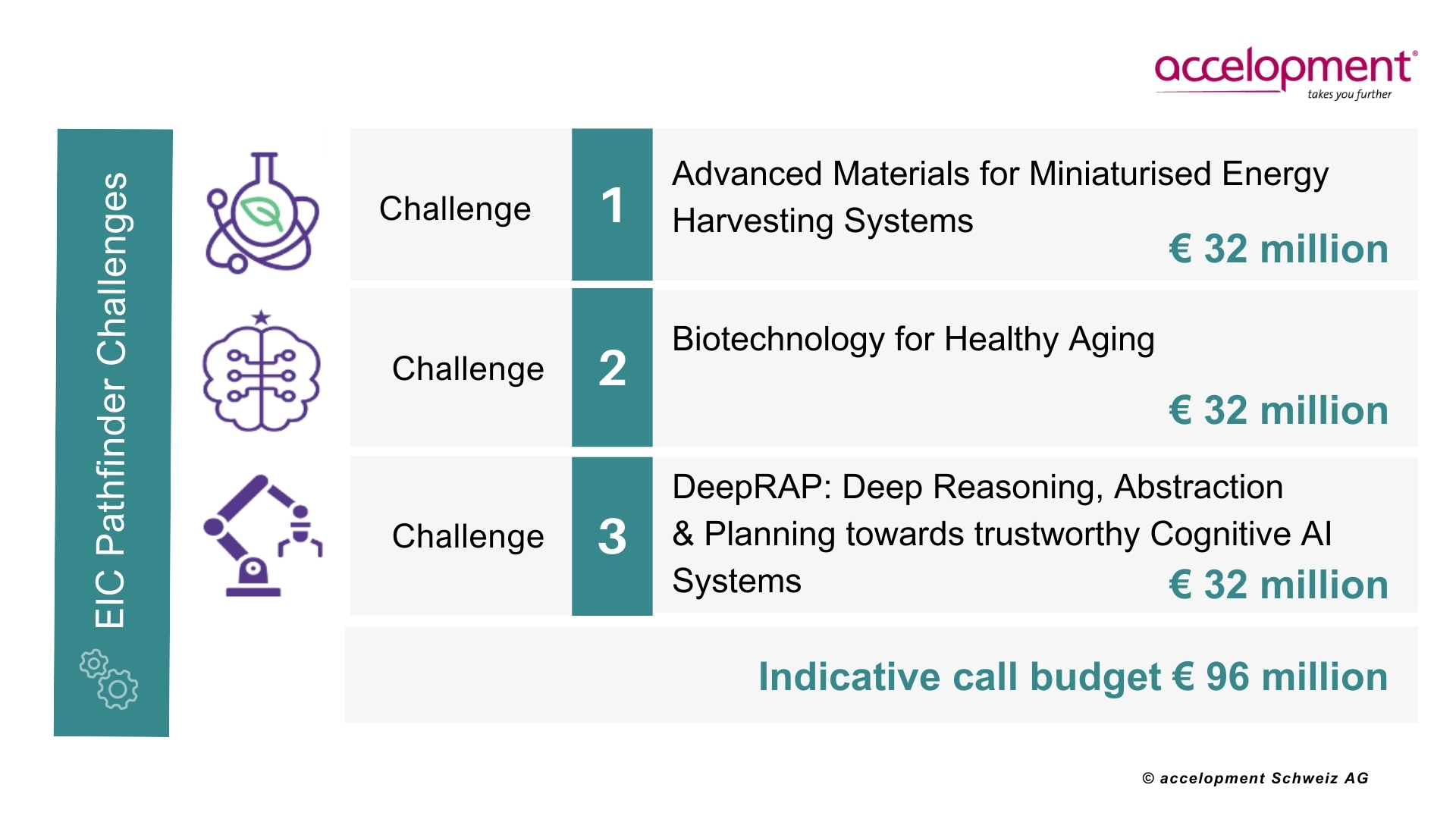
Challenge 1. Advanced Materials for Miniaturised Energy Harvesting Systems
To support the development of a new generation of energetically autonomous systems that enable innovative services to improve the quality of life for European citizens through applications in areas such as point-of-care diagnostics and smart, sustainable cities. These advancements should support sustainability in both energy consumption and production, in line with the ambitions of RePowerEU and the European Green Deal. Furthermore, this challenge will enhance the overall sustainability of the Internet of Things (IoT) and energetically autonomous systems in general.
Challenge 2. Biotechnology for Healthy Ageing
To develop biotechnology-based or pharmaceutical interventions that prevent, delay, or reverse age-related diseases. The Challenge will focus on advancing biotechnology for healthy ageing, promoting personalised care through molecular profiling, guiding policymakers and developers on regulatory approaches, and raising public awareness about healthy longevity.
Challenge 3. DeepRAP: Deep Reasoning, Abstraction & Planning towards trustworthy Cognitive AI Systems
To push scientific progress and help build a strong, collaborative community focused on practical applications of trustworthy cognitive AI. This challenge will lay the groundwork for Europe’s future leadership in safe and human-centred AI, strengthening competitiveness and technological sovereignty, while supporting the goals of the AI Act and the European approach to Artificial Intelligence.
What not to miss in your Pathfinder Challenges application?
If you are considering an EIC Pathfinder Challenge proposal and want to avoid the most common positioning and alignment pitfalls, don’t miss out on our earlier published blog “The five common pitfalls in your Pathfinder Challenge proposal”. It builds on practical experience from proposal evaluations and resubmissions and complements the strategic considerations outlined here. Taken together, these insights can help you assess whether your idea is not only excellent but also positioned in a way that gives it the best chance of success under a highly selective Challenge call.
Ready to embark on this adventure? We can support you!
At accelopment, we have supported a wide range of EIC Pathfinder proposals, including both Pathfinder Open and Pathfinder Challenges. Our experience includes successfully funded Challenge projects such as PEARL-DNA and the three recently approved Pathfinder Open projects BoneOscopy, CORENET, POLINA and PIONEAR. Do not let the narrow Pathfinder Challenges discourage you. With a strong consortium and a genuinely novel project idea, it is usually possible to further refine and align the concept to the specific Challenge requirements. If you would like to discuss whether and how your idea can be positioned to fit a Pathfinder Challenge, we would be glad to explore this with you.
Nothing suitable in EIC? We can identify other funding opportunities for you!
Not every strong innovation idea will be a perfect match for the EIC instruments (summarised in our recently published blog post), especially given their high selectivity and specific expectations. This does not mean that funding options are exhausted. On the contrary, many alternative opportunities across Horizon Europe may be better suited to your innovation’s maturity and objectives. Through our strategic grant planning, we help research teams navigate the funding landscape and decide where to focus their efforts. Through this service, we help position your project where it has the strongest chance of success and design a funding pathway that supports long-term development rather than a single call.

Andreia Cruz
Research & Innovation Project Manager

Dr. Eva Avilla Royo
Research & Innovation Project Manager