
From pollution hotspots to resilient waters: what evaluators expect at stage 1 for aquatic bioremediation
26th February 2026 at 9:48 am
Chemical pollution of Europe’s marine, freshwater and groundwater systems remains a major threat to ecosystems, biodiversity and human health. Persistent and mobile contaminants of emerging concern (CEC), including per- and polyfluoroalkyl substances (PFAS), antimicrobial substances and microplastics, continue to accumulate across interconnected aquatic environments. The two-stage Research and Innovation Action (RIA) HORIZON-CL6-2026-01-ZEROPOLLUTION-01-two-stage responds to this challenge by supporting innovative, life-science-based and biotechnological solutions to decontaminate and bioremediate aquatic pollution.
With a stage-1 deadline of 16 April 2026 and a total budget of €23.00 million for three projects, this call places strong emphasis on early credibility, environmental safety and policy relevance. Stage 1 is not exploratory. It is a decisive filter where evaluators assess whether a proposed bioremediation concept is realistic, site-adaptable and sufficiently evidence-based to justify full-scale development.
Understand the strategic logic and stage-1 expectations
With this topic, the European Union (EU) aims to equip competent authorities and the water sector with novel approaches delivering effective, affordable and environmentally safe solutions to remediate aquatic pollution while improving ecosystem resilience to climate change and biodiversity decline. Proposals must demonstrate how bioremediation approaches can function in complex, real-world aquatic systems, where multiple pollutants coexist, transform and interact with sediments, soils and biota.
At stage 1, proposals are expected to show how they build on and enhance existing monitoring methods, remediation knowledge and risk assessment frameworks, rather than duplicating previous efforts. The scope explicitly covers Europe’s groundwater bodies, rivers, lakes, coastal, transitional and marine waters and aligns with the European Ocean Pact, the Marine Strategy Framework Directive, the Water Framework Directive, the Groundwater Directive, the Environmental Quality Standards Directive, the European Water Resilience Strategy, the EU Zero Pollution Action Plan, the Nature Restoration Regulation, the Commission communication on Building the future with nature: Boosting Biotechnology and Biomanufacturing in the EU, the Life Sciences Strategy and the EU Biotech Act. Concepts that remain laboratory-bound or insufficiently connected to regulatory and management needs are unlikely to pass this first filter.
Must-have elements to be competitive at stage 1
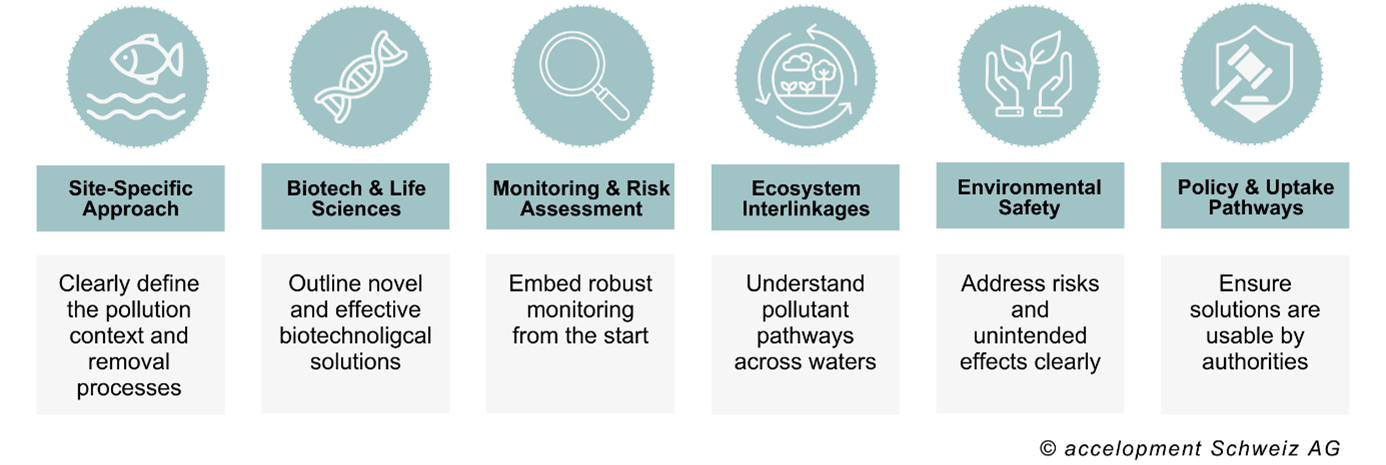
1. A clearly defined, site-specific bioremediation concept
Stage-1 proposals must clearly identify the pollution challenge addressed, including the type of aquatic system and target contaminants, and demonstrate why the proposed bioremediation, decontamination approach or removal process is suitable for that specific context. Evaluators expect solutions that are adaptable, locally relevant and designed to operate safely in complex environmental conditions.
Pro tip for applicants: Be explicit about where and under which conditions your solution works, and why this matters for authorities and water managers.
2. Credible life-science or biotechnology-based remediation pathways
The call strongly prioritises solutions based on pollutant-degrading microbes, microbial communities and biotechnological approaches, including combinations with nanotechnology advancements where appropriate. Stage-1 proposals must already outline the underlying molecular mechanisms, including degradation pathways, community dynamics and interactions with pollutants and transformation products.
Pro tip for applicants: Explain the biological logic of your approach in a way that non-specialist evaluators can assess its plausibility and safety.
3. Integration of monitoring and risk assessment from the outset
Bioremediation is expected to be informed by robust environmental monitoring, including effect-based methods and high-resolution detection of pollutants and their impacts. Proposals should demonstrate how monitoring supports both risk assessment and evaluation of remediation effectiveness, including ecosystem recovery and resilience.
Pro tip for applicants: Show how monitoring is embedded in your remediation strategy, not added later as a validation exercise.
4. Understanding pollutant pathways and ecosystem interlinkages
Evaluators will look for proposals that recognise the interconnected nature of aquatic systems, including links between marine, freshwater and groundwater environments. Understanding pollutant transport, accumulation and transformation is essential to identify where remediation and management actions are most effective.
Pro tip for applicants: Demonstrate system-level thinking by explicitly addressing cross-ecosystem pollutant pathways and feedbacks.
5. Environmental safety, risk management and unintended effects
Stage-1 proposals must already consider potential environmental risks associated with remediation activities, including impacts on non-target organisms, sediments and ecosystem functions. Adaptive management and mitigation measures are expected to ensure that remediation does not create new environmental pressures.
Pro tip for applicants: Treat environmental safety as a core design criterion, not a compliance afterthought.
6. Clear pathways for uptake by stakeholders
Finally, proposals must demonstrate how they bring together a wide range of stakeholders, including researchers, technology providers, policy makers, local water managers and competent authorities. Avoid overlaps and ensure complementarities with projects funded under the Mission “Restore our Ocean and Waters” and the Partnership for the Assessment of Risks from Chemicals (PARC). The aim should be to support the growth of an emerging community on decontamination and bioremediation envisaged under the European Water Resilience Strategy.
Pro tip for applicants: Make it clear how your project outcomes will change day-to-day decision-making for authorities responsible for water protection.
Have you decided to apply and are you looking for proposal preparation support?
At accelopment, we support consortia developing solutions that address environmental pollution, exposure risks and ecosystem protection in line with the EU zero pollution ambition. Our experience includes projects such as AIRTOXMONITOR and DECIDE, which strengthen monitoring, assessment and decision-support for environmental contaminants, EXPOSIM, advancing system-level understanding of exposure pathways and pollutant impacts, ECO-INDIA, addressing environmental resilience and ecosystem management, and PHOTONFOOD, linking advanced technologies to pollution detection and food system safety. Together, these projects reflect our ability to support interdisciplinary initiatives that combine monitoring, risk assessment and biotechnological innovation with strong policy relevance. From shaping credible stage-1 concepts to preparing stage-2 proposals, we are happy to help teams position aquatic bioremediation solutions as effective, safe and deployable pathways under Horizon Europe Cluster 6.

Dr. Johannes Ripperger
Research & Innovation Manager

Andreia Cruz
Research & Innovation Project Manager