
From pilots to policy: what evaluators look for at stage 1 when scaling Nature-based Solutions
24th February 2026 at 10:44 am
The transition of the European Union (EU) towards a nature-positive and climate-resilient economy depends on moving beyond isolated Nature-based Solutions (NbS) pilots. The two-stage Research and Innovation Action (RIA) HORIZON-CL6-2026-01-BIODIV-04-two-stage is designed to support concepts that can mainstream and scale up NbS across ecosystems, sectors and governance levels.
With a stage-1 deadline of 16 April 2026 and a total budget of €18.00 million for three projects, this call places strong emphasis on early strategic clarity, robust evidence and policy relevance. Below, we outline what not to miss when positioning your concept for success at stage 1.
Understand the strategic logic and stage-1 expectations
This topic aims to strengthen the evidence-based decision-making for NbS as systemic responses to biodiversity loss, climate change, water stress and socio-economic challenges. Proposals must demonstrate how NbS can deliver long-term environmental, social and economic benefits when implemented at scale, across terrestrial, freshwater, marine and urban ecosystems. At stage 1, proposals are expected to demonstrate how they build on and enhance existing NbS knowledge systems, databases and impact assessment frameworks, rather than duplicating past work.
The scope is ambitious but specific. It calls for large-scale pilots or interconnected NbS, credible and viable long-term projections, including Earth Observation (EO) and modelling, as well as early integration into policy, spatial planning and sectoral strategies such as water management, energy, transport and the built environment that support the conservation, protection, restoration and sustainable usage of ecosystems.
The call explicitly aligns NbS scaling with key EU and global policy frameworks, including the European Green Deal, the EU Biodiversity Strategy for 2030, the EU Climate Adaptation Plan, the EU Forest Strategy, the EU Preparedness Union Strategy, the Kunming–Montreal Global Biodiversity Framework (notably targets 2, 8 and 11), as well as the EU Water and Marine Acquis, the European Water Resilience Strategy and the European Ocean Pact.
At stage 1, evaluators expect clarity on scalability, cost-effectiveness, uncertainty and policy uptake. Concepts that rely mainly on local success stories, without a convincing pathway to systemic integration, are unlikely to pass this first filter.
Must-have elements to be competitive at stage 1
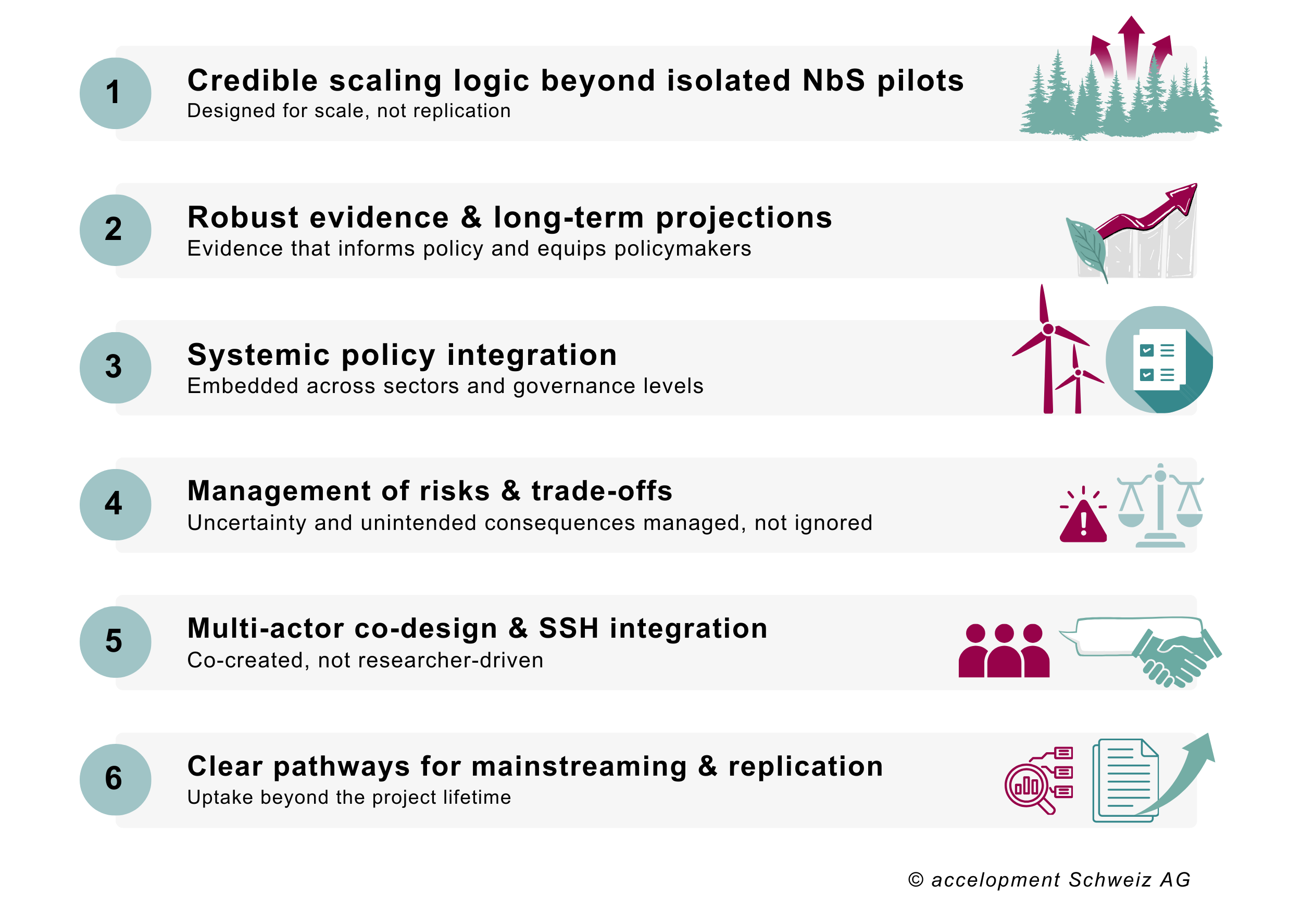
1. A credible scaling logic beyond isolated NbS pilots
Stage-1 proposals must show that the NbS concept is designed from the outset for scaling and mainstreaming, not merely replication of small pilots. Evaluators look for evidence that the proposed NbS can function across broader land- and seascapes while maintaining ecosystem integrity, connectivity and measurable outcomes. Where relevant, evaluators will also look for NbS designs that create additional co-benefits, such as disaster risk reduction or improved air quality, without compromising ecosystem integrity or primary biodiversity and climate objectives.
Pro tip for applicants: Explicitly explain what changes when NbS move from pilot to scale and how your concept addresses these challenges.
2. Robust, policy-aligned evidence and long-term projections
This call strongly emphasises scientifically credible evidence on the long-term effectiveness of NbS under diverse climate scenarios. Proposals should already outline how EO data, modelling and monitoring will generate projections on performance, cost-effectiveness, maintenance needs and ecosystem dynamics over time. Proposals are also encouraged to explicitly address knowledge gaps identified in relevant assessments of the Intergovernmental Science-Policy Platform on Biodiversity and Ecosystem Services, particularly regarding the long-term effectiveness, trade-offs and system-level impacts of NbS across ecosystems.
Pro tip for applicants: Show at stage 1 that your evidence strategy is credible enough to inform policy decisions, not just scientific publications.
3. Systemic policy integration across sectors and governance levels
NbS are expected to be integrated across policy domains, including climate adaptation and mitigation strategies, water resilience, biodiversity, urban planning and infrastructure. Stage-1 proposals must demonstrate awareness of how NbS interact with existing policies and how they can be embedded into planning and decision-making processes to ensure economic security and opportunities.
Pro tip for applicants: Map early how your NbS concept connects to at least two relevant policy domains and decision-making levels.
4. Management of risks, trade-offs and unintended consequences
Evaluators will assess whether proposals acknowledge and address uncertainties and risks, including unintended ecological, social or economic impacts of NbS at scale. Adaptive management approaches and learning mechanisms are expected, particularly under changing climatic and societal conditions.
Pro tip for applicants: Treat uncertainty as a design feature, not a weakness, and explain how adaptive management will be operationalised.
5. Multi-actor co-design and SSH integration
The call explicitly encourages a multi-actor approach and the integration of social sciences and humanities. Stage-1 proposals should show how researchers, practitioners, policymakers, public authorities and civil society will co-design, implement and assess NbS.
Pro tip for applicants: Clearly indicate who co-designs what, and at which stage, rather than listing stakeholders generically.
6. Clear pathways for mainstreaming, replication and uptake
Finally, proposals must demonstrate how the developed knowledge, tools and practices will enable wider adoption of NbS beyond the project. This requirement includes dedicated tasks with EU NbS Task Forces, coordination with other EU-funded projects and, where relevant, financial support to third parties, as well as appropriate resources to ensure close cooperation with the European Commission’s Knowledge Centre for Biodiversity and its Science Service to support policy uptake and EU-level biodiversity assessments.
Pro tip for applicants: Describe early how your project will leave behind usable mechanisms for replication, not just recommendations.
Are you preparing a stage-1 proposal and looking for strategic support?
At accelopment, we support consortia developing solutions that contribute directly to the European Green Deal and long-term environmental sustainability. Our experience includes projects such as SOLARX, PEPPERONI and CHEOPS, which advance climate-positive energy systems, HEAT-INSYDE, focusing on efficiency and reduced environmental footprints, as well as PHOTONFOOD and ViroiDoc, addressing sustainable and resilient food systems. Through REALISE, we have also supported capacity building and skills development for environmental and resource sustainability.
Together, these projects reflect our ability to support interdisciplinary, impact-driven initiatives that link robust evidence, policy relevance and scalable implementation. From shaping strong stage-1 concepts to preparing evaluator-ready stage-2 proposals, we help teams position NbS as credible, cost-effective and policy-ready pathways under Horizon Europe Cluster 6.

Dr. Johannes Ripperger
Research & Innovation Manager

Andreia Cruz
Research & Innovation Project Manager