
Dr. Johannes Ripperger
Research & Innovation Manager

The Eurostars for research and innovation (R&I) projects is attractive because it gives innovative SMEs a route to non-dilutive funding for market-oriented international R&I. Yet one of its most important features is also one of the easiest to underestimate: Eurostars is international in structure, but funding is national.
For applicants, the practical question is therefore not only “Is the consortium eligible?” It is also “Can each partner be funded in its own country or region, with this role and budget?” That distinction should be checked before a consortium is fixed.
Eurostars supports collaborative R&I projects led by innovative SMEs. The current Eurostars country list includes many European countries and several non-European participants such as Canada, Singapore, South Africa and South Korea. This makes Eurostars broader than a purely European scheme.
However, not every European country is a Eurostars country and not every Eurostars country has the same funding setup for each call. The Call 11 rules already published by EUREKA, the administrative body of the Eurostars programme, state that National Funding Bodies decide which organisations can receive funding, which activities can be funded and which rates apply. National or regional criteria may therefore sit alongside the international Eurostars eligibility criteria.
Eurostars consortia must be led by an innovative SME from a Eurostars country. A consortium must include at least two independent organisations from at least two Eurostars countries, with at least one organisation from an EU Member State or Horizon Europe Associated Country. SMEs from Eurostars countries must account for at least 50% of total project costs, excluding subcontracting. These are international eligibility criteria.
One important practical note: current Eurostars guidance also includes other international rules, such as no single participant or country exceeding 70% of the budget, project duration of 36 months or less, and exclusive civil application.
They do not automatically answer the funding question for each partner. Large companies, universities, research organisations and other partners may participate if they meet the rules, but whether they receive grant funding depends on national or regional rules. Organisations from non-Eurostars countries may participate only by self-funding their project costs.
The Call 10 application figures are useful because they show where applicant demand is concentrated. The 687 submitted applications represent a larger pipeline than Call 9, while the strong presence of electronics, IT and telecoms suggests continuing interest in digital and technology-intensive innovation projects. However, Call 10 figures should not yet be presented as funding results. The publicly available information identified for this update covers application statistics and the official evaluation timetable, not the final number of projects recommended for funding.
For SMEs considering the next Eurostars deadline, the message is straightforward: competition is substantial, and a technically promising idea is not enough. Evaluators and national funding bodies need to see a coherent international consortium, a convincing route to market, a credible work plan and financial assumptions that can withstand both the Eurostars evaluation and national checks.
Country-specific differences can be substantial. Some countries fund SMEs, large companies and research organisations or universities. Others fund SMEs only. Some fund research organisations only where a domestic SME or company is involved. In some countries, universities or research organisations can be included only as subcontractors or self-funded participants.
Examples show why early checks matter. Canada supports eligible Canadian SMEs through NRC IRAP, while other organisation types are not funded directly. South Korea includes funding categories for SMEs, medium-sized companies, large companies and research organisations or universities, but with specific national conditions. Belgium illustrates the regional dimension: Brussels currently has no allocated budget for Call 11, while Flanders and Wallonia apply different rules for companies and research organisations.
There are also cases where a country is listed as a Eurostars country, but no budget, revised procedures or restricted rules apply for a given call. This can affect otherwise strong consortium ideas if the funding assumptions are checked too late.
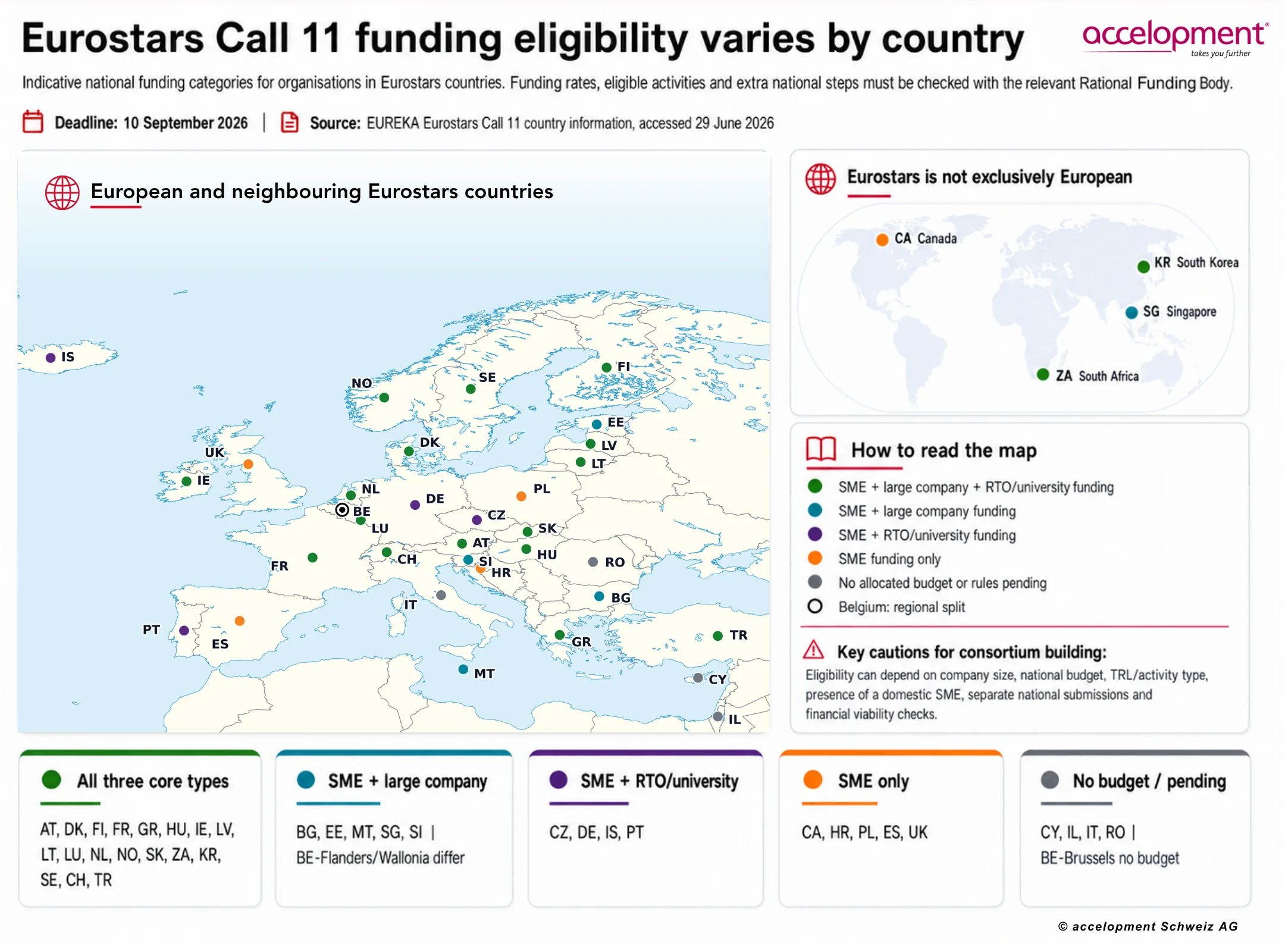
A practical Eurostars funding check should be carried out before partner roles and budgets are fixed. At minimum, applicants should verify whether:
• each partner is based in a Eurostars country for the relevant call;
• the partner’s organisation type can receive national or regional funding;
• funding rates, caps and eligible cost rules are compatible with the proposed budget;
• funding for a research organisation, university or larger company depends on the involvement of a domestic SME or company;
• additional national applications, forms or deadlines apply alongside the Eurostars submission;
• partners need SME declarations, financial documents, commitment forms or self-funding declarations.
These checks are not only administrative. They affect the credibility of the budget, the allocation of work packages, the composition of the consortium and the ability of partners to deliver their tasks after approval.
Planning your next Eurostars application? Drawing on our team’s extensive experience with successful projects such as FP-Catheter, AirToxMonitor and the recently approved ASCEND project, accelopment supports Eurostars applicants from early project screening through to proposal submission. Our experts review country-specific funding assumptions, advise on consortium composition, and support proposal writing, partner coordination and final submission. Contact our experts to discuss how we can support your next Eurostars proposal.