
Horizon Europe Health proposals: 1,444 submissions and what they mean for 2026
4th March 2026 at 10:47 am
The European Commission has now published the official results statistics for the 2025 Horizon Europe Health proposals. Following the September 2025 deadline and the completion of evaluations, we can finally assess how competitive each Destination and topic truly was. With over 1,000 proposals submitted across single-stage and stage 1 two-stage topics, the 2025 calls confirmed once again Cluster 1 Health as one of the most competitive parts of Horizon Europe. Below, we break down what the numbers reveal and what they mean for applicants preparing for 2026.
Overall picture: high pressure across most Destinations
The Horizon Europe Health calls closed on 16 September 2025 with strong interest across all six Destinations. In total, 1,444 proposals were submitted: 749 to single-stage call topics, and 695 to stage 1 of two-stage call topics, for a total budget of over €789 million. Below, we break down what the numbers reveal and what they mean for applicants preparing for 2026.
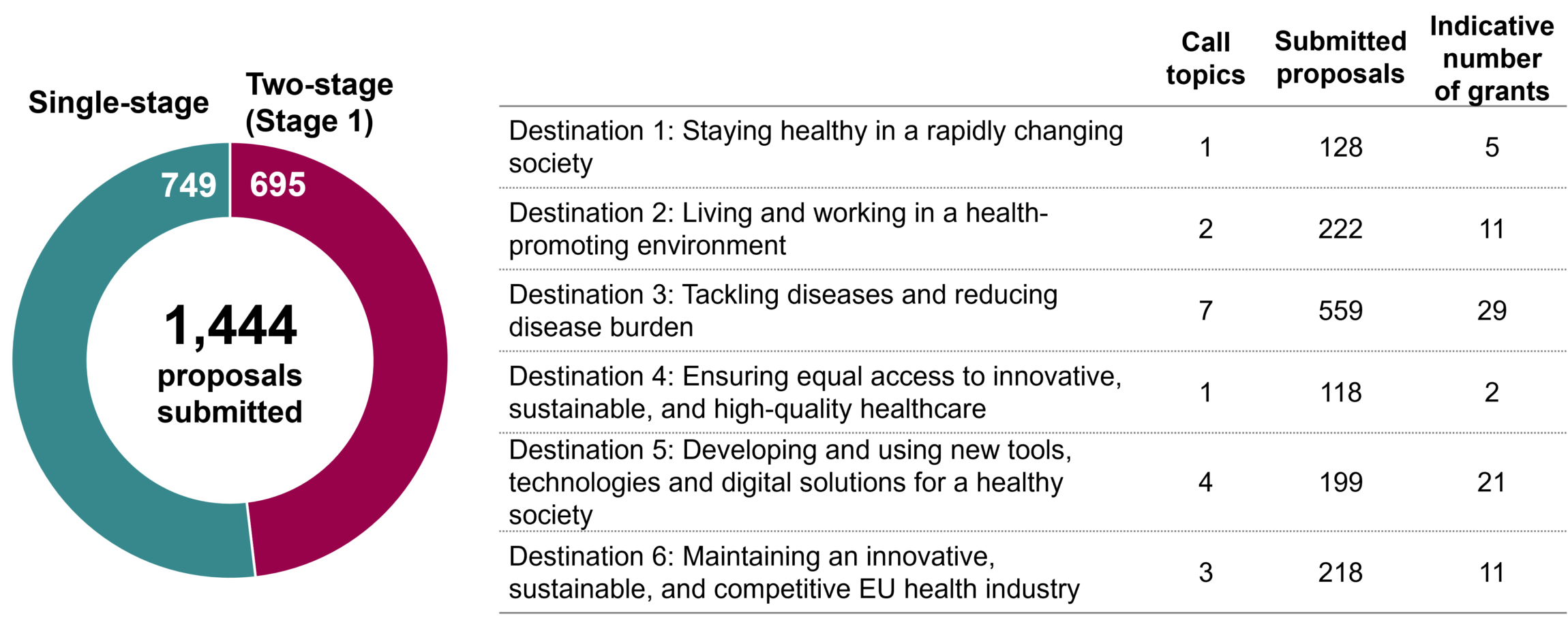
The 2025 results for Horizon Europe Health proposals confirm a highly competitive landscape across almost all Destinations. In single-stage topics under Destination 3 alone, submission numbers ranged from 15 proposals in antibody development to 158 in health systems implementation research, with success rates varying between 3.2% and 27%. Particularly striking are the 1.7% success rate in HORIZON-HLTH-2025-01-CARE-01 on generative AI in healthcare and the 3.2 percent in HORIZON-HLTH-2025-01-DISEASE-06, demonstrating intense pressure in high-visibility and policy-driven areas. By contrast and, surprisingly, structurally broader topics such as HORIZON-HLTH-2025-01-TOOL-05 reached a 40 per cent success rate due to higher numbers of funded projects.
| Destination 3: Tackling diseases and reducing disease burden | ||||||||||
| Call topic | Type of Action | Budget (EUR million) | Budget/ project (EUR million) | Submitted proposals | Approved proposals | Success rate | ||||
| HORIZON-HLTH-2025-01-DISEASE-01: Testing safety and efficacy of phage therapy for the treatment of antibiotic-resistant bacterial infections | RIA | 45.00 | Around 15.00 | 30 | 3 Funding threshold: 14 | 10% | ||||
| HORIZON-HLTH-2025-01-DISEASE-03: Development of antibodies and antibody-derived proteins for the prevention and treatment of infectious diseases with epidemic potential | RIA | 50.00 | Around 10.00 | 15 | 4 Funding threshold: 14.5 | 27% | ||||
| HORIZON-HLTH-2025-01-DISEASE-04: Leveraging artificial intelligence for pandemic preparedness and response | RIA | 35.00 | 6.00 to 8.00 | 76 | 4 Funding threshold: 14.5 | 5.3% | ||||
| HORIZON-HLTH-2025-01-DISEASE-05: Support for the functioning of the Global Research Collaboration for Infectious Disease Preparedness (GloPID-R) | CSA | 2.00 | Around 2.00 | 7 | 1 Funding threshold: 13 | 14% | ||||
| HORIZON-HLTH-2025-01-DISEASE-06: Implementation research addressing strategies to strengthen health systems for equitable high-quality care and health outcomes in the context of non-communicable diseases (GACD) | RIA | 20.00 | 3.00 to 4.00 | 158 | 5 Funding threshold: 15 | 3.2% | ||||
| HORIZON-HLTH-2025-01-DISEASE-07: Tackling high-burden for patients and under-researched medical conditions | RIA | 30.00 | Around 6.00 | 83 | 4 Funding threshold: N/A | 4.8% | ||||
| Destination 4: Ensuring equal access to innovative, sustainable, and high-quality healthcare | ||||||||||
| Call topic | Type of Action | Budget (EUR million) | Budget/ project (EUR million) | Submitted proposals | Approved proposals | Success rate | ||||
| HORIZON-HLTH-2025-01-CARE-01: End user-driven application of Generative Artificial Intelligence models in healthcare (GenAI4EU) | RIA | 40.00 | 15.00 to 20.00 | 118 | 2 Funding threshold: 15 | 1.7% | ||||
| Destination 5: Developing and using new tools, technologies and digital solutions for a healthy society | ||||||||||
| Call topic | Type of Action | Budget (EUR million) | Budget/ project (EUR million) | Submitted proposals | Approved proposals | Success rate | ||||
| HORIZON-HLTH-2025-01-TOOL-01: Enhancing cell therapies with genomic techniques | RIA | 50.00 | 8.00 to 10.00 | 57 | 5 Funding threshold: N/A | 8.8% | ||||
| HORIZON-HLTH-2025-01-TOOL-02: Advancing cell secretome-based therapies | RIA | 40.00 | 9.00 to 13.00 | 35 | 3 Funding threshold: 14 | 8.6% | ||||
| HORIZON-HLTH-2025-01-TOOL-03: Leveraging multimodal data to advance Generative Artificial Intelligence applicability in biomedical research (GenAI4EU) | RIA | 50.00 | 15.00 to 17.00 | 82 | 3 Funding threshold: 15 | 3.7% | ||||
| HORIZON-HLTH-2025-01-TOOL-05: Boosting the translation of biotech research into innovative health therapies | RIA | 80.00 | 4.00 to 8.00 | 25 | 10 Funding threshold: 12 | 40% | ||||
| Destination 6: Maintaining an innovative, sustainable, and competitive EU health industry | ||||||||||
| Call topic | Type of Action | Budget (EUR million) | Budget/ project (EUR million) | Submitted proposals | Approved proposals | Success rate | ||||
| HORIZON-HLTH-2025-01-IND-01: Optimising the manufacturing of Advanced Therapy Medicinal Products (ATMPs) | IA | 40.00 | 6.00 to 8.00 | 58 | 5 Funding threshold: 14 | 8.6% | ||||
| HORIZON-HLTH-2025-01-IND-02: Digitalisation of conformity assessment procedures of medical devices and in vitro diagnostic medical devices | CSA | 4.00 | Around 4.00 | 5 | 1 Funding threshold: 12.5 | 20% | ||||
New this time: Summary of observer report
As published under the Cancer Mission call topics, two independent observers followed the evaluation of proposals, including briefings for experts that took place in this period. Below are their comments:
- The entire evaluation process was fully transparent and followed all applicable rules and guidelines. The latter were clearly communicated to experts at the start of the process, during general and topic specific briefings and, by the moderators, during central evaluation and the panel meetings as needed. The HaDEA staff involved, including quality checkers and call secretariat team, conducted the evaluation in an excellent and impartial manner, ensuring a high quality of the process.
- Achieving this high level was extremely difficult due to the high number of proposals to be processed in a limited time and with limited resources. Over 1,500 proposals were assessed through tremendous effort. Given the constant increase in proposal numbers and in view of not compromising the quality of the evaluation, it is highly recommended to consider adapting the process.
- The fast-track procedure and the use of recorders were both useful tools and should be continued. Some of the calls were part of a blind evaluation pilot. We advise against this practice, which had no visible advantage, but in some instances impaired the evaluation of scientific excellence, especially with respect to methodology.
- We see it as a weakness of the process that it focuses strongly on finding negative aspects but does not reward particularly exciting or highly innovative proposals. This is linked to the low weight that is given to scientific excellence, which is only 1/3. The observers are not aware of any other evaluation process that places such a low emphasis on scientific excellence. Increasing its weight would be in line with international practice and would allow to place more emphasis on genuine break-through concepts.
Looking ahead: opportunities in the 2026 Horizon Europe Health Work Programme
With the 2025 results statistics now available and the next deadline for 2026 call topics already on the 16 April 2026, now it’s the last chance to act. If you are considering submitting new Horizon Europe Health proposals in 2026, we encourage you to revisit our earlier blog post analysing the upcoming Health Work Programme. The call topics are already open on the Funding & Tenders Portal, which means consortia building, work plan and proposal structuring should be well underway.
Horizon Europe health initiatives – our team helps you turn your ideas into projects
At accelopment, we have extensive experience in securing EU funding for research and innovation projects, with a strong track record in Horizon Europe Health projects, including some successful proposals from the September 2025 deadline that are already in grant preparation. Additionally, our portfolio includes many Horizon Europe Health projects, including HUNADIA, EDiHTA, EU PAL-COPD, GENEGUT and more. Our team of experts supports researchers, companies and institutions throughout the entire funding process – from strategic grant planning, to proposal writing, project management and communication and dissemination. With deep knowledge of Pillar II Health funding opportunities, we help our partners maximise their chances of success in securing European health research grants. In need of support for your ongoing Health proposal? Get in touch with our experts to see how we can support you in turning your idea into a competitive proposal.