
EUREKA-Eurostars consortium building – choosing eligible partners for the March 2026 Eurostars call
16th January 2026 at 11:35 am
The next EUREKA Eurostars call is now open, and it’s time to get started with your application (deadline: 19 March 2026)! A strong consortium is essential, but it must also meet strict eligibility rules, including partner country eligibility. This blog explains how to build a compliant consortium and choose the right partners.
The 2026 Eurostars call – why consortium composition matters
As with every Eurostars call, your consortium is not only a strategic choice, but also a formal eligibility condition. Even an excellent project idea can become ineligible if the partnership structure does not comply with the programme rules. Eurostars is designed for international, market-oriented R&D projects, with a strong role for innovative SMEs. It supports collaborations across thematic fields, provided the project aims to develop a product, process or service with clear commercial potential. One of the most common early-stage challenges we see is how to select partners from eligible countries and build a consortium that is both strong and compliant.
Who must be in an Eurostars consortium?
Eurostars uses a set of international eligibility criteria. Before writing your proposal in depth, you should ensure that your consortium meets these rules:
- The consortium must be led by an innovative SME based in a Eurostars country.
- The consortium must include at least two independent entities.
- Partners must come from at least two Eurostars countries, and at least one participant must be established in an EU Member State or a Horizon Europe Associated Country.
- SMEs from Eurostars countries must represent at least 50% of the total project budget (excluding subcontracting).
- No single participant or single country may account for more than 70% of the total budget.
- Project duration is a maximum of 36 months, and the project must have an exclusive focus on civil applications.
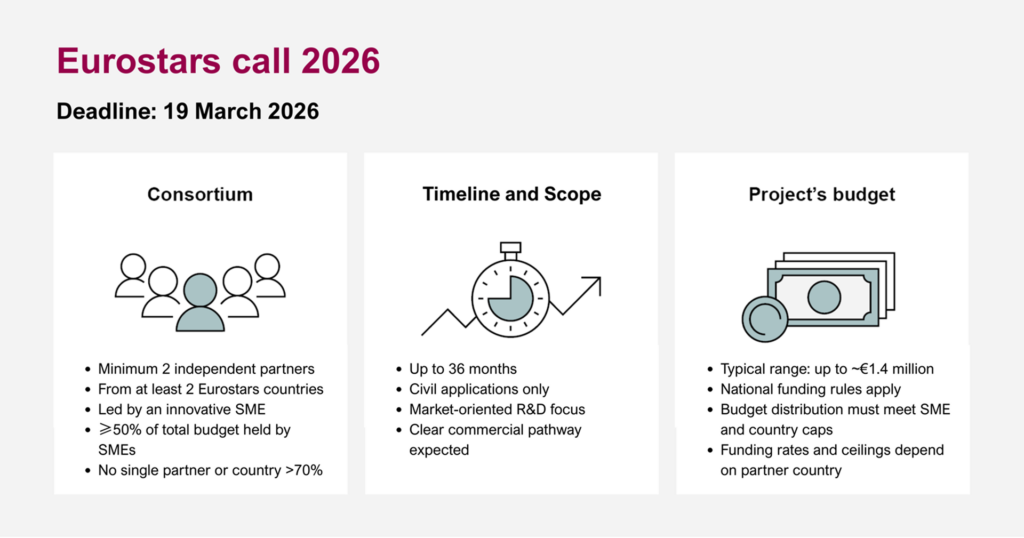
These rules are evaluated early in the process. In practice, the most frequent problems relate to the lead partner (innovative SME requirement), the country mix and budget distribution.
Partner selection starts with Eurostars country eligibility
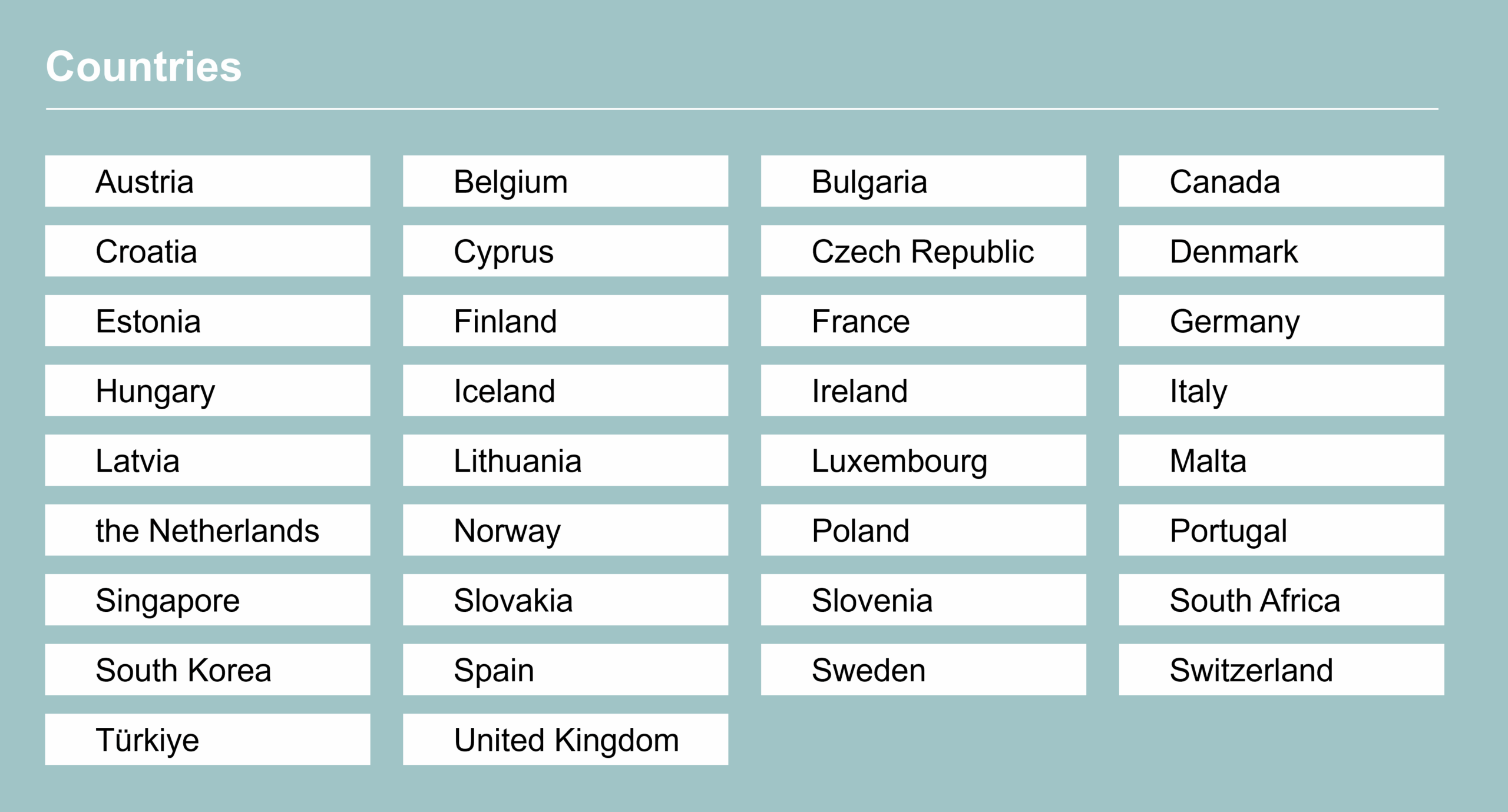
A consortium is only eligible if all participating organisations are established in Eurostars participating countries, or if non-participating organisations join at their own cost (self-funded participation can be possible, but it must be considered carefully because it affects the budget balance and the overall value proposition). For the 2026 call, there are some changes in eligible countries. For example, Greece and Romania currently have no allocated budget for organisations participating in this Eurostars Call 10 for projects.
Eligibility checks can be time-consuming, particularly when comparing rules across multiple countries and partner types. To simplify this step, accelopment provides a practical tool. Our online Eurostars eChecker helps you quickly assess whether:
- your organisation is eligible,
- your project setup aligns with Eurostars rules, and
- your consortium structure is likely to comply with key eligibility requirements.
How to build a compliant and competitive Eurostars consortium
1) Start with the lead SME and build around its market ambition
Eurostars is built around the assumption that the innovative SME is driving commercialisation. Your partner selection should therefore reflect a clear logic: who provides the missing expertise needed to build, validate, and prepare market uptake? A strong Eurostars consortium often combines:
- a lead SME as the product owner and commercial driver,
- one or more technology partners (SMEs, research organisations, universities) to strengthen the R&D, base – Ideal case is a technology-developing SME from a different Eurostars country than the lead SME,
- validation, pilot, clinical/industrial testing, or end-user partners (where relevant),
- manufacturing, scale-up, or certification expertise if it is critical for market readiness.
Even though Eurostars is relatively flexible in consortium size, selection should remain intentional. Adding partners without a clear role can weaken the proposal narrative and introduce eligibility and budget complexity.
2) Ensure you meet the “at least two countries” rule early
At minimum, you need partners from two Eurostars countries and at least one must be in an EU Member State or Horizon Europe Associated Country. To avoid late-stage restructuring, treat this as a first-step constraint, not something to fix near submission. If you are building a two-partner consortium, verify early that:
- partners are located in two different countries,
- both partners are in eligible countries (see list above), and
- the budget shares remain compliant (SME share, 70% cap).
3) Plan budget shares while selecting partners, not afterwards
Consortium eligibility is tightly linked to budget structure:
- SMEs from Eurostars countries must hold ≥50% of the total project budget (excluding subcontracting),
- No single participant or country can exceed 70% of the total budget.
In practice, this means partner selection is also a budgeting exercise. If you plan to include a strong research organisation, make sure the SME budget share stays above the 50% threshold, and the research partner’s role is cost-effective and well justified.
4) Anticipate national rules that affect partner roles
Eurostars funding is administered by national funding bodies, and the funding rules vary by country. This can influence:
- which organisation types can receive funding,
- funding rates and ceilings,
- whether universities/research organisations must be included under specific conditions,
- what cost categories are fundable.
This is why partner selection should include a quick “national rule check” before the consortium is finalised, especially when working with universities and research organisations, large companies, or partners located in countries with stricter national participation conditions.
How accelopment supports Eurostars applicants
At accelopment, we support organisations across the full Eurostars proposal lifecycle, from early concept development to submission and follow-up. Our team specialises in international R&D funding and collaborative project design, with a particular focus on innovation-driven SMEs and research-performing organisations. We support applicants in:
- building balanced and compliant international consortia
- translating technical excellence into a convincing market and impact narrative
- ensuring compliance with eligibility, budgeting, and national funding rules
- managing proposal writing, review cycles, and submission workflows efficiently
Our experience includes successful Eurostars proposals such as FP-Catheter, AirToxMonitor, and the recently approved ASCEND project as well as a broader track record including OPTO-BRAIN, MAXCOAT, NoCaTS, sus@pension, MiniLib, and RETWood. If you are considering applying to the Eurostars call opening on 16 January 2026, we recommend starting with two concrete steps: 1) Confirm your partner countries against the 2026 eligibility list, and 2) validate your consortium structure early using our Eurostars eChecker.
If you would like expert input on consortium composition, partner selection strategy, or proposal drafting, you are welcome to contact us to discuss your project and maximise your chances of success.


Dr. Johannes Ripperger
Research & Innovation Manager

Yannic Fechtig
Innovation & Digitalisation Associate